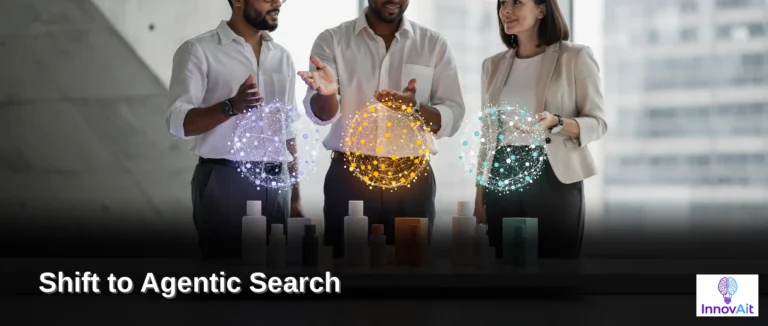
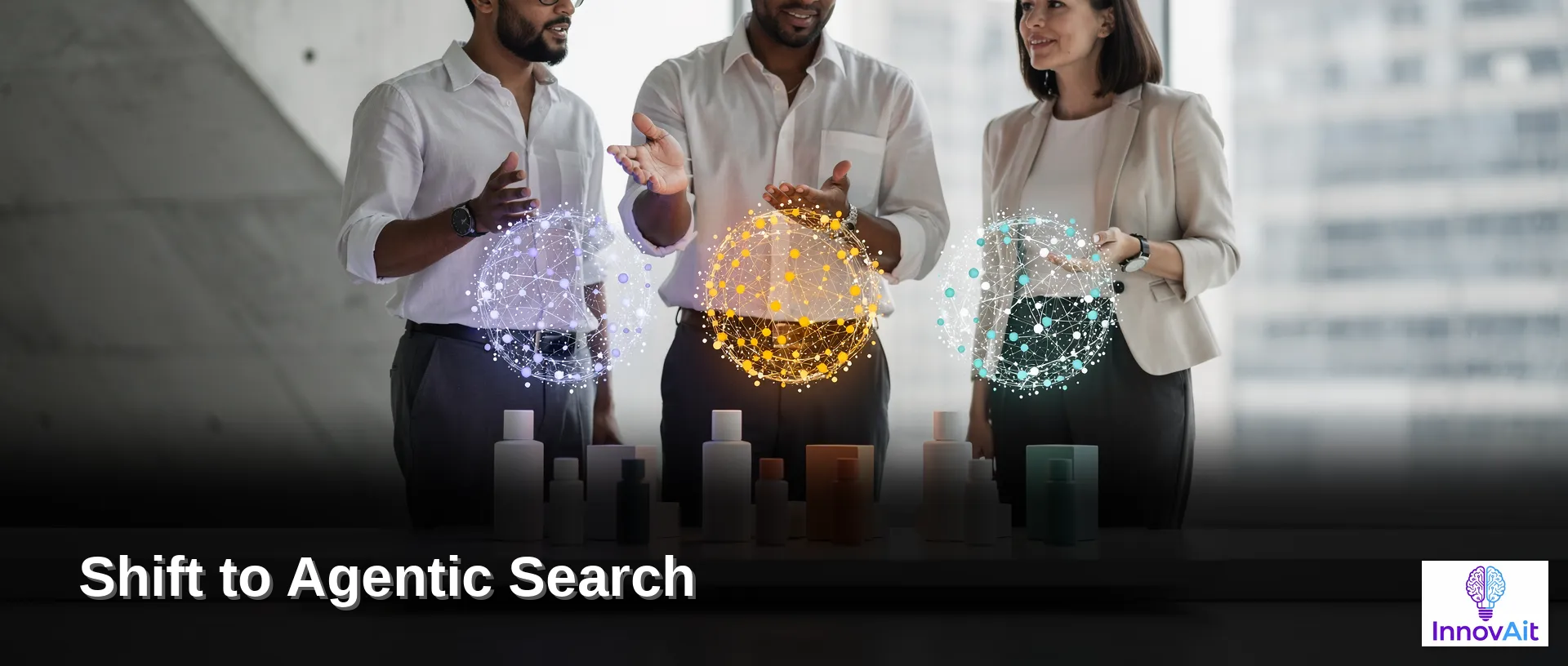
Agentic AI engines like Meta Muse, OpenAI dots, and Grok Bot now research and shortlist brands autonomously, bypassing traditional search results. Our 2026 research shows brands must optimize for autonomous agent retrieval or risk invisibility. InnovAit AI helps enterprises dominate this new discovery layer.
Key Takeaways
Agentic engines like Muse, Dots, and Grokbot bypass search results pages entirely, executing tasks without user oversight.
Brands invisible to autonomous agents never enter the consideration set, losing transactions without recorded impressions or clicks.
Citation frequency across agentic platforms replaces click-through rate as the leading indicator of brand discoverability.
Structured data, entity-rich language, and concise answer formats become primary ranking signals for agentic retrieval.
Transition from conversational answer engines to autonomous agentic execution
AI search engines no longer just answer questions. They execute tasks. Agentic search optimization addresses a fundamental shift where AI agents research, shortlist, and act on behalf of users without ever showing a results page. The final click disappears. Demand becomes invisible to traditional analytics.
This transition changes what brand visibility means. Conversational engines like ChatGPT and Perplexity still surface answers for human review. Autonomous agents like Muse and Dots AI search engine visibility platforms operate differently. They bypass the search results page entirely. The agent researches options, evaluates brands, and completes the transaction. The user never sees the shortlist.
How do autonomous agents change brand discovery?
Autonomous agents make decisions without human oversight at the moment of selection. A user asks Muse to book a service. The agent researches providers, checks availability, and confirms the booking. The brand either appears in that agent’s knowledge base or loses the transaction. No impression gets recorded. No click gets measured.
This machine-to-machine dynamic demands a new optimization approach. AEO for autonomous AI agents structures brand information so agents can retrieve, verify, and cite it during autonomous execution. The optimization target shifts from ranking for human eyes to being machine-readable and machine-trusted.
What makes agentic search optimization different from traditional AEO?
Traditional Answer Engine Optimization (AEO) focuses on getting cited when AI answers a question. Agentic search optimization goes further. It ensures the brand survives the full autonomous pipeline: discovery, evaluation, shortlisting, and transaction execution. The distinction matters because agents make binary choices. A brand is either included or excluded.
Grokbot brand citation optimization follows the same principle. Grokbot operates as an always-on agent with its own cloud computer, executing tasks autonomously. Brands that structure entity data, maintain clean product feeds, and build verified knowledge graph presence get cited. Brands that optimize only for page rankings do not.
We see this pattern across every agentic platform. The agent does not browse. It queries its internal knowledge structures. If a brand’s information lives in structured, verified, machine-accessible formats, the agent finds it. If the brand relies on webpage rankings alone, the agent passes over it. The cost of invisibility compounds with every autonomous transaction that goes to a competitor.
Why does the final click no longer measure demand?
Agents execute tasks without generating clicks. A completed booking through Muse produces zero organic traffic for the winning brand. The transaction happened. The demand was real. The analytics report shows nothing. Brands measuring success by click volume miss the demand that agents capture.
This reality forces a redefinition of visibility metrics. Citation frequency across agentic platforms replaces click-through rate as the leading indicator of discoverability. We track whether agents include a brand in their decision paths, not whether users clicked a link. The measurement framework shifts from traffic analytics to presence analytics.

The architectural roles of Muse, Dots, and Grokbot
Muse, Dots, and Grokbot serve distinct architectural functions in the agentic AI ecosystem. Each agent operates with different levels of autonomy, transaction capability, and brand citation logic. Understanding these differences determines whether a brand gets cited, purchased from, or ignored entirely.
Meta’s Muse functions as a transaction-completion agent. Muse can browse, coordinate tasks, and act on someone’s behalf. This means the agent does not simply recommend products. It completes purchases. For brands, this shifts the optimization target from click-through rates to transaction-path integrity. Clean product data and seamless purchase paths become non-negotiable. If Muse encounters friction during checkout, the transaction fails. The brand loses the sale without ever knowing the agent attempted it.
OpenAI Dots and Grokbot operate as always-on agents with their own cloud computers. They execute complex, multi-step workflows without human intervention. Dots persists across sessions, maintaining context and completing tasks over extended periods. Grokbot performs similarly, running autonomously in its own compute environment. These agents research, compare, and shortlist options before a human ever sees the results. Brands invisible to these agents never enter the consideration set.
How does AEO for autonomous AI agents differ from traditional SEO?
AEO for autonomous AI agents requires content structured for machine parsing and autonomous decision-making. Traditional SEO optimizes for human readers and search engine crawlers. Agentic AEO optimizes for systems that read, interpret, and act on content without displaying it to a person. Structured data, entity-rich language, and concise answer formats become the primary ranking signals. If an agent cannot extract a clear, factual answer about what a brand offers, it moves to a competitor that provided cleaner data.
Which agent is most reliable for real-world brand transactions?
None of these agents is reliable at real work yet. The best model still fails to complete real freelance projects to a professional standard. This reliability gap creates both risk and opportunity. Brands that structure their data correctly now position themselves for the moment these agents mature. The architectural foundation matters more than current performance. As enterprise brand visibility shifts from search rankings to AI citation, early optimization compounds.
The practical implication is straightforward. Muse and Dots AI search engine visibility requires transaction-ready data structures. Grokbot brand citation optimization demands entity clarity and authoritative source signals. We treat these as separate workstreams because the agents process information differently. Muse needs purchase-path integrity. Dots needs persistent context signals. Grokbot needs unambiguous entity relationships. A single optimization approach fails across architectures.

The Machine-to-Machine Trust Protocol: Knowledge Graphs, schema, entity validation
AI systems resolve entities across sources they already trust, then decide whether to cite a brand. That decision happens before a single user types a query. The protocol governing this process is entirely machine-to-machine. No human reviews your site. No algorithm crawls your pages the way Google does. An agent queries its trusted knowledge graph, validates your entity, and either retrieves your content or ignores it.
How do AI agents validate a brand before citing it?
Validation starts with entity resolution. The agent checks whether your brand exists as a coherent, disambiguated entity across multiple authoritative sources. If your business appears as three slightly different names across directories, the agent sees noise, not a brand. Structured data matters here. Schema markup that explicitly defines your organization, its services, and its geographic scope gives the agent a clean entity to resolve. Without it, the agent cannot confirm who you are.
The next layer is knowledge graph optimization. We structure brand knowledge assets so retrieval-augmented generation systems can extract context accurately. Grokbot brand citation optimization depends on this exact mechanism. Grokbot and similar agents pull from knowledge graphs via RAG retrieval. Entity-rich language and properly formatted structured data determine whether your content surfaces in that retrieval step. If your site runs on a JavaScript framework that renders a blank page to crawlers, you are invisible before the race even starts.
What role does schema markup play in agentic search visibility?
Schema provides the machine-readable layer agents need to validate and categorize your brand. AEO for autonomous AI agents requires more than traditional SEO schema. Agents performing agentic search optimization look for entity definitions, relationship mappings, and service classifications that confirm your brand is a verified source. We manage entity disambiguation across knowledge graphs to ensure AI algorithms recognize the brand consistently. One version of your business name. One verified entity. That consistency is what earns citation.
Muse and Dots AI search engine visibility follows the same trust protocol. These agents do not browse. They retrieve. The knowledge graph is their index, and schema is your entry pass. Brands that treat schema as an afterthought lose the retrieval race before any user sees a result.

The InnovAit AI Agentic Readiness Framework
Agentic search optimization demands a fundamentally different readiness model than traditional SEO. We built our framework around one hard truth: if an AI agent cannot find, verify, and cite your brand, you do not exist in the agentic economy. The framework assesses four interconnected layers that determine whether autonomous AI agents select your brand or bypass it entirely.
What makes a brand citable by autonomous AI agents?
AEO for autonomous AI agents starts with structured knowledge that AI models can extract and trust. We conduct LLM visibility audits that map exactly where your brand appears across ChatGPT, Perplexity, Claude, Gemini, and Grok. Most brands discover they are invisible in the engines their customers now use daily. The audit identifies gaps in entity recognition, factual consistency, and source authority that prevent AI systems from treating the brand as a verified answer.
Building authoritative AI brand citations closes those gaps. AI models cite sources they recognize as credible and consistent. We optimize knowledge entities across the open web, structured databases, and proprietary AI indexes so algorithms classify the brand as a reliable source. This is not link building. It is entity disambiguation and knowledge graph optimization designed for retrieval-augmented generation systems.
How does paid media influence agentic search visibility?
Paid media plays a specific role in agentic discovery that most frameworks overlook. Muse and Dots AI search engine visibility depends partly on familiarity signals that paid channels create. When Meta’s AI agent Muse evaluates options, brands with established trust signals earn consideration. Paid media builds the familiarity and trust that earns a brand its spot on the agent’s shortlist, according to research on where brands live in an agentic AI world.
Clean product data and frictionless purchase paths complete the transaction. But the brand must first be discoverable inside AI search engines, not just Google. Our framework treats paid media as a trust accelerator that feeds the organic AI citation engine. One without the other leaves the pipeline incomplete.
How does benchmark research inform readiness scoring?
Data separates opinion from strategy. Our 2026 AI Search Benchmark Study provides the quantitative foundation for every readiness assessment we deliver. The study measures citation frequency, entity accuracy, and competitive positioning across all major AI platforms. We score brands against industry-specific benchmarks rather than generic metrics.
Grokbot brand citation optimization follows the same evidence-based approach. We test how Grok retrieves and represents brand information, then optimize against those specific patterns. Every recommendation traces back to measured performance data, not assumptions about how AI search should work. The framework turns AI search optimization from a theoretical exercise into a measurable business function.
FAQ
What makes agentic search optimization different from traditional AEO?
Agentic search optimization ensures the brand survives the full autonomous pipeline of discovery, evaluation, shortlisting, and transaction execution, while traditional AEO only targets citation in AI answers.
Which autonomous AI engines redefine brand discovery in 2026?
Meta Muse, OpenAI dots, and Grokbot research and shortlist brands autonomously, bypassing traditional search results entirely.
Where is InnovAit AI located?
InnovAit AI is located in Coral Springs, FL, US.
Conclusion
The shift to agentic search is not coming. It is here, and it has already rewritten the rules of brand discovery. Muse, Dots, and Grokbot do not browse. They retrieve, validate, and decide. A brand that fails entity resolution, skips schema, or ignores knowledge graph optimization simply does not exist in their world. The choice is straightforward: build the machine-readable trust signals these agents demand, or watch them hand your customers to a competitor who did.