Make Your Brand Visible Inside
ChatGPT
Visibility today means being understood by machines, not just indexed by search engines.
What Is Answer Engine Optimization (AEO)?
Answer Engine Optimization (AEO) is a digital marketing strategy focused on structuring and optimizing content so AI-powered answer engines—such as ChatGPT, Google’s AI Overviews, and Perplexity—can surface it directly as clear, trusted answers. Instead of competing for clicks through traditional search links, AEO positions your brand to be referenced, quoted, and cited within AI-generated responses when users are actively searching for solutions.
Why Is AEO Important Now?
As more people turn to generative AI tools for research and decision-making, visibility is shifting away from traditional, click-based SEO toward being featured directly in AI answers. High-intent buyers are increasingly using AI to discover products and services, bypassing standard search results altogether. With organic traffic declining and over 60% of searches now resulting in zero clicks, businesses that don’t adapt to AEO risk losing visibility at the exact moment customers are ready to buy.
Our Proven AEO Process: Deep Question Research to AI-Friendly Content
At InnovAit AI, we implement a proven, systematic process that positions your site for both search engines and the AI-driven answer engines shaping the future of online discovery.
Deep Question Research
We identify the real questions your customers are asking across search engines, AI platforms, and voice search.
Content Strategy & Restructuring
We optimize and reorganize your content into AI-friendly frameworks - FAQs, schema-ready lists, and direct answer blocks.
Technical AEO Enhancements
We implement schema markup, optimized metadata, and technical improvements to enhance speed, mobile performance, and security.
Authority Building
We develop strategic content hubs and internal linking structures that establish your brand as a trusted authority.
Monitoring & Improvement
We measure real-world search and AI visibility, then continuously improve your content to keep pace with algorithm and platform changes.
semrush, optimization, generative engine optimization, search engine optimization, seo, traditional seo, answer engine optimization, answer engine optimization services, aeo services, aeo agency
The Biggest Search Shift Since Google in 1998
Your customers are already asking AI. Make sure you stay in control of the answer.

AEO Strategy
Custom AEO/GEO strategies tailored to your business goals, data, and target audience.

Content Creation
High-quality, on-brand content creation and optimization to keep your website fresh and relevant.

Technical SEO
Comprehensive technical audits including site speed, crawl errors, indexing issues, and performance fixes.
LLM Placement
Optimize your brand’s presence inside AI tools like ChatGPT, Google AI, and other large language models.
Link Building
Increase domain authority with high-quality backlinks from trusted and relevant websites.
Keyword Research
In-depth keyword research based on search intent, competition analysis, and ranking opportunities.
Cutting-edge GEO suite
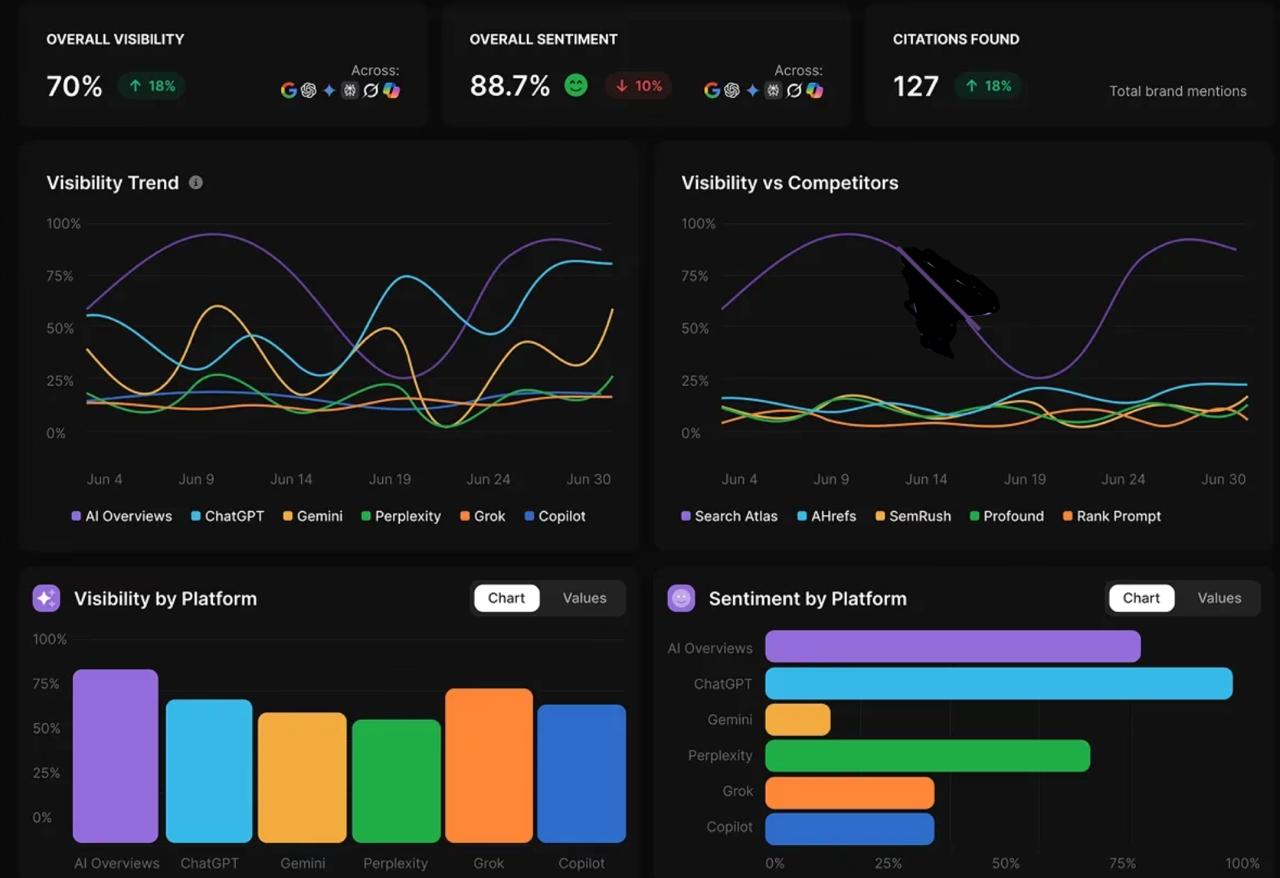
Visibility and AI-generated answers — competitor insights, source trust, prompt realism, sentiment, and actionable fixes.
Visibility and Tracking
See how often your clients are mentioned across AI-generated answers—and where they're missing entirely.
Competitor Analysis
Understand which competitors show up instead, how frequently, and in what context.
Source & Citation Insights
Identify which websites, publications, and directories AI models trust when forming answers.
Prompt Simulation
Test real-world, intent-based prompts that mirror how people actually ask AI questions.
Brand Sentiment
Track whether brands are framed positively, neutrally, or negatively in responses.
Recommendations
Clear guidance on what to fix, create, or amplify across technical, content, and link building categories.
Work Process
Seamless process, stellar solutions
Find out how we transform your ideas into digital solutions by learning how our efficient work process can turn them into digital solutions.
Discovery
Understanding client goals.
Strategy
Crafting a tailored plan and approach.
Development
Building and coding the solution.

Launch
Deploying the final product live.
What is Answer Engine Optimization (AEO) and why does it matter in 2026?
Answer Engine Optimization (AEO) is a digital marketing strategy that structures and optimizes content so AI-powered answer engines like ChatGPT, Google’s AI Overviews, Perplexity, Claude, and Gemini can surface it as clear, trusted answers. AEO matters because over 60% of searches now result in zero clicks, AI search queries grew 500%+ year-over-year, and 35% of Gen Z users search on large language models instead of traditional search engines. Without AEO, businesses lose visibility when customers are actively searching for solutions.
How is AEO different from traditional SEO?
AEO focuses on being cited and referenced within AI-generated answers, while traditional SEO focuses on ranking in search engine results pages for clicks. AEO requires structured, answer-friendly content that AI systems can parse and understand, including FAQ formats, concise responses, schema markup, and entity-rich language. Traditional SEO optimizes for keywords and backlinks to rank higher in link-based results, which is becoming less effective as AI answer engines bypass traditional search results entirely.
What is GEO (Generative Engine Optimization)?
GEO is a four-step framework built on the Search Party platform designed to establish control and scale brand presence inside AI-driven search. The GEO framework consists of: Prompts (surfacing high-intent questions buyers ask AI), Analytics (tracking visibility, sentiment, citations, and competitors), Content (creating atomic, scannable content structured for AI readability), and Exposure (distributing content across high-authority sources to reinforce narrative signals for LLMs).
Why are many modern websites invisible to AI search engines?
Approximately 63% of websites are completely inaccessible to AI search crawlers because they’re built with modern JavaScript frameworks that render blank pages to AI crawlers. Platforms like ChatGPT, Perplexity, and Claude cannot access content on these sites because the frameworks require JavaScript execution to display content, which AI crawlers typically cannot perform. Traditional SEO tools don’t solve this infrastructure problem because they assume crawlers can already see the content.
Which AI search engines does InnovAit AI optimize for?
InnovAit AI optimizes for all major AI answer engines including ChatGPT (with 2.5+ billion monthly search queries), Google’s AI Overviews, Perplexity, Claude, Gemini, and Grok. The optimization strategy ensures brand visibility across the entire AI search ecosystem rather than focusing on a single platform, protecting businesses as search behavior continues fragmenting across multiple AI assistants.
What does InnovAit AI's AEO process include?
InnovAit AI’s AEO process follows five steps: (1) Deep Question Research to uncover real customer questions across search engines, AI prompts, and voice search, (2) Content Strategy & Restructuring to format content as FAQs, lists, and concise responses, (3) Technical AEO Enhancements including schema markup, optimized metadata, and site improvements for speed, mobile, and security, (4) Authority Building through content hubs and internal links, and (5) Monitoring & Improvement to track performance and refine content as algorithms evolve.
How can businesses measure their AI search visibility?
InnovAit AI’s GEO suite provides visibility tracking showing how often brands are mentioned in AI-generated answers, competitor analysis revealing which competitors appear instead, source and citation insights identifying which websites AI models trust, prompt simulation testing real-world intent-based queries, brand sentiment tracking whether brands are framed positively or negatively, and clear recommendations on what to fix, create, or amplify.
What is the projected growth of the AEO marketing market?
The AEO marketing market is projected to reach $9+ billion by 2031, reflecting the fundamental shift in how people discover information online. AI search engines are expected to dominate online search within 2+ years, with ChatGPT alone processing 2.5+ billion monthly search queries and overall LLM search growing 500%+ year-over-year, while traditional Google search grows only 20%+ year-over-year.
What technical elements are essential for AI crawler accessibility?
Essential technical elements for AI crawler accessibility include server-side rendering or static site generation instead of client-side JavaScript rendering, properly implemented schema markup for structured data, fast page load speeds, mobile optimization, HTTPS security, clear site architecture with logical internal linking, and XML sitemaps. Without these foundational elements, even perfectly optimized content remains invisible to AI search engines.
How does content formatted for Google rankings perform in AI citations?
Content optimized solely for Google rankings often performs poorly in AI citations because AI answer engines prioritize different signals than traditional search engines. While Google values backlinks and keyword density, AI engines prioritize answer clarity, structural formatting, entity recognition, and source authority. Content must be restructured with direct answers, FAQ formatting, and semantic richness to perform well in AI citations, which is why businesses need AEO strategies beyond traditional SEO.