By Eric Siversen, InnovAit AI
As the digital landscape continues to evolve, understanding the nuances between Answer Engine Optimization (AEO) and Search Engine Optimization (SEO) is crucial for marketers and business owners. This article provides a comprehensive overview of these two pivotal optimization strategies, focusing on how they differ and their respective applications in 2026. Readers will gain valuable insights into the mechanisms of aeo vs seo, the role of generative engine optimization in enhancing search visibility, and emerging trends in the realm of digital marketing.
The rise of artificial intelligence has fundamentally transformed how users interact with search engines, considerably increasing the relevance of AEO. While SEO emphasizes traditional keyword strategies and authoritative link building, AEO targets delivering accurate, direct answers to user queries—often through AI-driven content formats. This guide explores essential definitions, differences, practical applications, and how generative engine optimization influences the future of search optimization strategies in an AI-driven landscape.
AEO vs SEO in 2026: What Is Answer Engine Optimization and How Do They Compare?
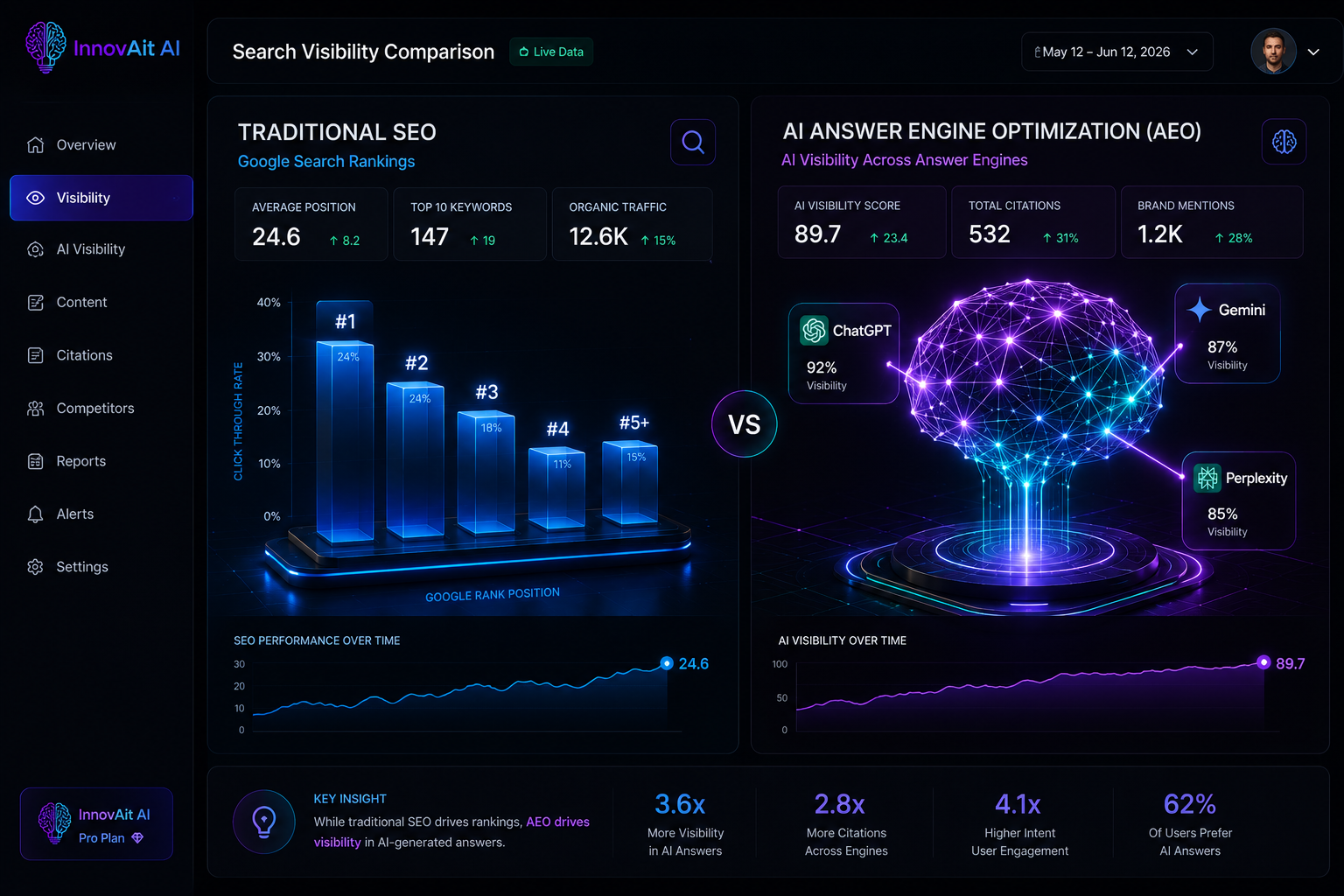
In 2026, AEO and SEO will coexist but fulfill distinct roles within the digital marketing ecosystem. AEO prioritizes understanding user intent and delivering immediate, precise information, whereas SEO centers on improving visibility through higher rankings in conventional organic search results. Businesses aiming to thrive must comprehend the aeo vs seo distinctions and strategically integrate both to maximize reach and engagement.
AEO vs. SEO: Why Your 2026 Strategy Needs Both
Answer Engine Optimization (AEO) is a strategy designed to optimize content that directly addresses user queries, specifically catering to AI search engines and answer engines. This contrasts with Search Engine Optimization (SEO), which involves enhancing web content to improve rankings on traditional search engine results pages, focusing on keyword targeting and content authority.
Key Differences Between AEO vs SEO Strategies
- Focus: AEO targets providing concise, direct answers to queries, while SEO emphasizes ranking improvements to increase site traffic.
- Content Structure: AEO requires a streamlined content layout prioritizing brief, relevant responses optimized for AI parsing; SEO favors comprehensive, keyword-rich articles designed for depth and breadth.
- User Interaction: AEO aims to boost engagement through quick satisfaction of queries, particularly in voice search, whereas SEO drives long-term traffic and brand authority.
Application Scenarios for AEO and SEO
AEO excels in situations where users need fast, straightforward answers. For example, voice search queries naturally benefit from AEO as users phrase questions conversationally. SEO remains effective for businesses focused on broader online visibility through in-depth content strategies designed to attract diverse audiences.
Future Trends in AI Search Optimization: The Rise of Generative Engine Optimization
Emerging advancements in AI technology continue to reshape the search optimization landscape. AEO is expected to grow in importance as more users rely on voice assistants and AI-powered answer engines for instant results. Concurrently, SEO strategies will evolve by incorporating semantic search and natural language processing to maintain relevance.
Integral to this shift is generative engine optimization, a cutting-edge technique leveraging AI-driven content creation to improve search visibility. Generative engine optimization enables businesses to produce highly relevant, dynamic content tailored to user intent, substantially enhancing performance across both AEO and SEO channels.
Organizations like InnovAit AI remain committed to educating marketers and business owners on effectively combining AEO, SEO, and generative engine optimization to amplify digital presence and attract targeted audiences in this evolving environment. When planning your search strategy for 2026, it’s critical to understand how long it takes to see results from Generative Engine Optimization before allocating budget.
What Is Answer Engine Optimization? Core Components and Strategic Insights
Answer Engine Optimization (AEO) is specifically engineered for AI-powered search engines and answer engines. It focuses on optimizing content to provide immediate, accurate responses rather than conventional ranking objectives.
Core Components Defining Answer Engine Optimization
- User Intent Analysis: Decoding user queries to deliver precise and relevant answers.
- Content Structure Optimization: Crafting easily digestible content for AI parsing, often through bullet points, FAQs, and concise paragraphs.
- Use of Structured Data and Schema Markup: Enhancing machine readability by embedding semantic metadata to clarify content context.
Key Differences Between AEO and SEO Strategies
- AEO Objectives: Provide immediate, direct answers aligning with user needs.
- SEO Objectives: Achieve sustainable ranking improvement and organic traffic growth.
- Content Presentation: AEO favors short, Q&A-style formats; SEO supports in-depth articles targeting broader keyword variations.
Generative Engine Optimization: Enhancing AI Search Visibility and Content Performance
Generative engine optimization is a transformative approach that leverages large data sets and artificial intelligence to generate high-quality, relevant content aligned with user questions and search intent.
Techniques and Tools Employed in Generative Engine Optimization
- AI-Powered Content Creation: Utilizing advanced algorithms to automate and customize content generation.
- Behavioral Data Analysis: Tracking user engagement and search trends to inform content strategies.
- Natural Language Processing (NLP): Enabling deeper understanding of context and nuances in user queries.
Benefits of Generative Engine Optimization for AI Content Generation and Rankings
- Improved Content Relevance: Producing tailored and engaging content that matches user expectations.
- Higher Search Rankings: Increasing the probability of appearing in top AI-driven search results.
- Enhanced User Engagement: Delivering precise answers promptly to sustain audience interest and interaction.
Benefits and Use Cases of AEO Compared to SEO for Brands in 2026
Brands leveraging AEO benefit from improved visibility in AI-generated search results, increased user satisfaction due to direct answers, and elevated engagement metrics. Case studies reveal that brands integrating AEO strategies experience higher click-through rates and better conversion outcomes, particularly when optimizing for voice search and instant-answer platforms.
Industries That Benefit Most from AEO Integration
- Healthcare: Providing immediate information on health symptoms and treatments.
- Retail: Delivering quick product information and comparison answers.
- Education: Enhancing learning experiences through fast access to relevant information.
Impact of AEO and SEO on Brand Metrics: CTR and Impressions
AEO boosts click-through rates by offering users quick, satisfying answers directly addressing their questions. Meanwhile, SEO typically generates greater overall impressions over time by attracting traffic through broad content reach and authoritative rankings.
AI Algorithms and Semantic Entities Affecting Search Visibility in 2026
Advanced AI algorithms and semantic entities play a critical role in shaping search visibility. Machine learning models analyze user behavior patterns and context variables, allowing search engines to deliver highly pertinent results that go beyond simple keyword matching.
Role of Semantic Search in AI Rankings
Semantic search enables AI engines to interpret the underlying user intent and contextual meaning behind queries. This enhances the ability of search engines to return relevant and precise results, improving the effectiveness of both AEO and SEO techniques.
Voice Search Optimization and Answer Engines in AEO Strategies
Optimization for voice search and answer engines improves user experience by facilitating natural language interactions. With the increasing prevalence of voice-activated devices, incorporating AEO tactics tailored for voice queries is essential for brands targeting future market dominance.
Implementing and Monitoring Effective AI Search Optimization Frameworks
Marketers can achieve success by integrating AEO, SEO, and generative engine optimization within a cohesive AI search optimization framework. Continuous performance monitoring, including regular audits and adaptation to dynamic AI engine criteria, ensures content remains relevant, accessible, and optimized.
Businesses such as InnovAit AI support exploration of advanced strategies that elevate search visibility. By applying best practices informed by data-driven insights, brands can meaningfully increase their online visibility and more effectively engage their target audiences in the evolving digital landscape.