What Measurable AEO Results Can a Business Expect From Answer Engine Optimization?
By Eric Siversen, InnovAit AI
In the evolving landscape of digital marketing, Answer Engine Optimization (AEO) has emerged as a crucial strategy for businesses seeking tangible outcomes from their online efforts. By aligning content with the way users interact with search engines, especially AI-powered answer engines, AEO aims to enhance visibility and drive engagement. This article delves into the measurable aeo results businesses can expect, focusing on key answer engine optimization metrics, performance benefits, and authoritative best practices. Companies often struggle to quantify the effectiveness of their digital strategies, but AEO provides a pathway to understanding concrete results through precise metrics and detailed analysis. We will explore essential AEO metrics, how AEO outperforms traditional SEO, and how to calculate aeo roi effectively.
Measurable ROI: What to Expect from AEO Strategies
Answer engine optimization metrics are vital for businesses to accurately gauge online performance aligned with modern search behavior. These metrics cover a variety of quantitative indicators reflecting user engagement, traffic quality, and conversion efficiency. By understanding these metrics, companies can better assess the unique performance advantages AEO delivers over traditional practices.
Measurable aeo results are critical for strategic decision-making, enabling businesses to optimize content effectively and demonstrate tangible returns.
Key Answer Engine Optimization Metrics Explained
Several core metrics define the effectiveness of AEO strategies, providing a multi-dimensional view of impact. Businesses should particularly focus on the following:
Search Visibility Metrics

Search visibility metrics measure how often AEO-optimized content appears in search engine results pages (SERPs), especially in AI-generated answer boxes and snippets.
- Changes in Search Rankings: Tracking ranking shifts for target queries reveals how well AEO improves brand prominence, often leading to featured snippet positions.
- Impact on Organic Traffic: AEO drives increased quality organic visits by optimizing for direct answers and AI interpretation, reducing bounce and improving engagement.
- Visibility in AI-Driven Results: Presence in AI answer blocks or voice assistant results is a unique and growing metric of AEO success.
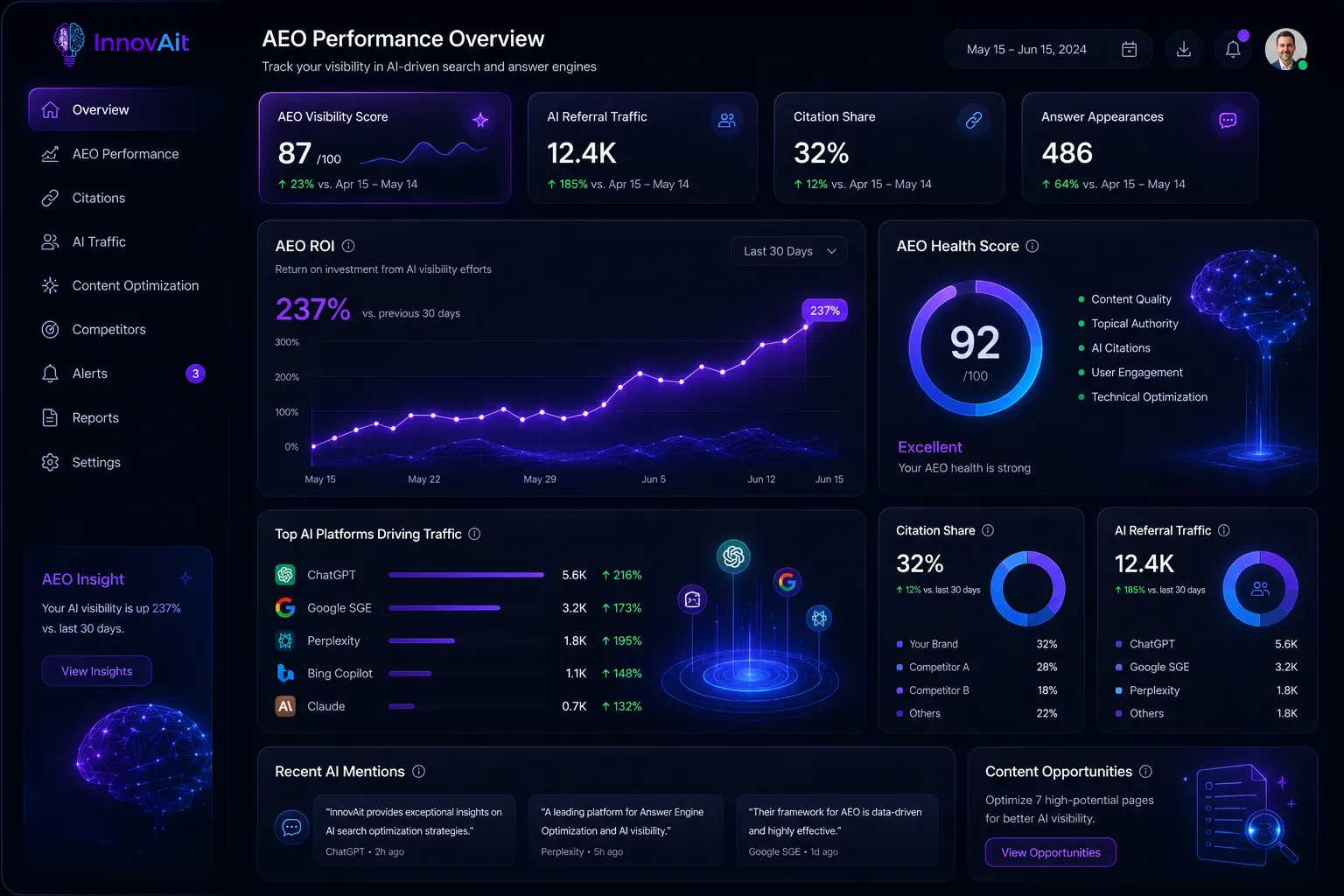
- Citation Share: This emerging metric tracks the percentage of AI answer citations attributed to your content, indicating authority and prominence in AI-driven search engines. Businesses typically use specialized AI analytics platforms to monitor citation frequency and shifts over time, allowing for strategic adjustment.
- Brand Mentions in Answer Engines: Monitoring mentions of your brand or products in AI responses highlights increasing recognition and trust, often tracked via AI-driven search monitoring tools.
- Referral Traffic from AI Engines: Measuring traffic directly originating from AI-powered search or answer platforms helps identify the effectiveness of AEO strategies, typically via advanced referral URL analysis and source attribution.
User Engagement Metrics

Metrics in this category assess how users interact with your AEO content, providing insights into content relevance and resonance.
- Bounce Rates and User Retention: Lower bounce rates indicate users find answers useful and stay engaged with the site.
- Time Spent on Site: Longer average session durations show effective content pulling users deeper into related resources.
- Interaction Rates: Tracking clicks, shares, comments, and other interactions reflects quality user engagement and content satisfaction.
Lead Generation Metrics
AEO has a direct impact on lead generation, and measuring this effect is essential.
- Number of Leads Generated: Increases in leads post-AEO implementation indicate a successful content-to-lead funnel.
- Conversion Rates: Monitoring lead conversions from AEO-driven traffic demonstrates effectiveness and customer journey completion.
- Zero-Click Search Impact: Analyzing how zero-click answers influence lead quality and volume offers advanced insights into user intent fulfillment.
Organic Traffic Growth Metrics
Growth in organic traffic is a key sign of AEO success, reflecting user trust and search relevance.
- Long-Term Traffic Trends: Sustained increases illustrate lasting AEO impact and content authority.
- Pre- and Post-AEO Comparisons: Evaluating traffic before and after AEO adoption quantifies growth clearly and justifies strategy investments.
- Targeted Audience Reach: Optimizing for audience intent enhances reach quality and engagement rates.
Conversion and Revenue Metrics
Assessing conversion rates and revenue growth is critical to determine aeo roi and overall financial benefit.
- Conversion Definitions: Clearly define desired actions (sales, sign-ups, inquiries) to measure specific success related to AEO efforts.
- Strategies Impacting Conversions: Identify which AEO content types or channels most effectively drive conversions.
- Revenue Growth Attributable to AEO: Track revenue changes linked to AEO initiatives using customer attribution models, supporting comprehensive ROI analysis. For example, if an AEO campaign drives 30% more organic leads with a 25% conversion rate and average order value ($1000), hypothetical ROI can be calculated considering costs and incremental revenue.
Performance Benefits Backed by AEO Results
Alongside metrics, the qualitative performance benefits of AEO lead to demonstrable business advantages:
Enhanced Visibility
- Increased Frequency in Search Results: Better optimization results in more frequent, prominent appearances including featured snippets and AI answer boxes.
- Elevated Brand Recognition: Consistent visibility fosters brand trust and authority across AI and traditional channels.
- Deeper Audience Understanding: AEO processes refine content to meet evolving user intents effectively, driving focused engagement.
Improved User Engagement
- Metrics Validate Higher Engagement: Data support increased session times, lower bounce rates, and more interaction events.
- Direct Answers Boost Satisfaction: Providing precise, helpful responses satisfies users, encouraging repeat visits and shares.
- Extended Visit Durations Improve Conversions: Engaged users are more likely to convert, enhancing funnel efficiency.
Automated and Enhanced Lead Generation
- Simplified Access to Information: Well-optimized answers streamline the customer journey, reducing friction.
- Enhanced Customer Funnel Efficiency: AEO facilitates smoother transitions from discovery to lead capture through targeted answers.
- Data-Driven Targeting: Analytics derived from AEO improve audience segmentation and campaign focus, optimizing spend.
Increased Sales and Customer Loyalty
- Building Trust Through Accuracy: Reliable, precise answers foster sustained consumer confidence and repeat business.
- Strengthened Long-Term Relationships: Continuous engagement supports loyalty and retention through personalized content.
- Quantifiable Revenue Growth: Businesses see measurable financial gains linked directly to AEO initiatives.
Faster, Actionable Results
- Rapid Visibility Improvements: Often noticeable within weeks post-AEO implementation, accelerating competitive advantage.
- Accelerated Engagement Rates: Optimized answers prompt quicker user response and action.
- Real-Time Performance Reporting: Enables agile adjustments and continuous improvement based on live data.
Cost-Effectiveness and High ROI
- Lower Budget Compared to Traditional SEO: AEO can deliver more efficient results for reduced costs, optimizing marketing spend.
- Clear ROI Metrics: Measuring leads, conversions, and revenue ensures alignment of cost to returns.
- Long-Term Financial Sustainability: Enduring benefits justify initial investments, supporting growth plans.
What Is Answer Engine Optimization and Why Does It Matter for Business Growth?
Answer Engine Optimization (AEO) refers to the process of tailoring content so answer engines—such as Google’s featured snippets and AI-powered search technologies—understand, select, and respond with it effectively. This optimization prioritizes high-quality, precisely structured content that matches modern user queries and consumption preferences.
AEO represents a strategic shift for businesses to capture visibility and engagement through conversational AI and voice search platforms, making it essential to stay competitive. Exploring AI solutions for businesses can provide deeper operational insights.
How Does AEO Differ From Traditional SEO? Key Differences Explained
AEO and traditional SEO may appear similar but differ fundamentally:
- Focus on Context and Intent: AEO prioritizes user intent and contextual answers over broad keyword targeting.
- Answer-Specific Optimization: Content is optimized for precise, direct answers to questions.
- AI and Voice Search Compatibility: AEO adapts to emerging AI-driven search interfaces and voice queries.
- Enhanced Engagement Emphasis: Instead of just rankings, AEO measures engagement and user satisfaction metrics.
These distinctions make AEO often more effective in the evolving search ecosystem dominated by AI assistants and voice-enabled devices.
For perspective, consider a forward-looking projection: a comprehensive hypothetical 2026 study envisions analysis comparing SEO, AEO, and GEO across multiple performance metrics, highlighting their respective advantages and limitations. While the study is a forecast synthesizing current trends and expert modeling, it offers valuable insights for strategic planning.
AEO Performance Data: A Comparative Study of SEO, AEO, and GEO Metrics (Hypothetical 2026 Industry Forecast)
This projected 2026 analysis by Iyappan, discussed in marketing intelligence circles, models 162 analytical units—including traditional search engines, answer-based systems, generative AI platforms, content samples, and AI query outputs—to evaluate performance variations across eight metrics. It forecasts where optimization paradigms excel and identifies unique strengths and boundaries.SEO, AEO, GEO: Projected Performance Data Illustrating Optimization Paradigm Impact
Which Key Performance Indicators Reflect AEO Effectiveness?
Accurately tracking key performance indicators (KPIs) is critical for measuring AEO success. To ensure authoritative assessment and enable strategic optimization, businesses should prioritize a structured hierarchy of KPIs addressing visibility, engagement, conversions, and brand authority metrics:
- Search Visibility Indicators: These include rank positions for targeted queries tailored by AEO, percentage reach in AI answer boxes, citation share in AI outputs, and frequency of brand mentions across AI answer platforms. Tracking tools and AI-specific analytics are essential here to obtain precise data.
- Engagement Metrics: Measured through bounce rates, average time on page, pages per session, and active user interactions (clicks, shares, comments). These reveal the depth of content resonance and user satisfaction with AEO-enhanced content.
- Conversion Metrics: Including volume of leads generated, form submission rates, purchases, or other goal completions directly attributable to AEO content. Multi-touch attribution models help distinguish AEO contributions from broader marketing influences.
- Brand Authority Metrics: Citation share and brand mention frequency in AI-powered answer engines reflect growing industry recognition and contextual authority. Monitoring should include both quantitative counts and qualitative analysis of mention sentiment and placement quality.
- Referral Traffic from AI Platforms: Establishing the proportion of site visits originating from AI-driven search engines and voice assistants via detailed referral traffic and source attribution analytics ensures comprehensive performance insight.
This structured approach enables businesses to better diagnose which AEO strategies are effective, optimize continuously, and provide actionable insights for stakeholders.
Core Metrics to Measure AEO Impact on Business Performance
Identifying core metrics helps correlate AEO performance with broader business outcomes. These include:
- Organic Traffic Levels: Volume and quality of visits originating from optimized answer engine results.
- Business Analytics: Insights into visitor behavior, customer journey progression, and engagement quality.
- Conversion Statistics: Detailed reporting on leads, sales, and revenue growth driven by AEO initiatives.
Tools like GrowthSpree offer advanced models for attributing dark-funnel pipeline metrics, critical for capturing hidden AEO ROI.
Quantifying AEO Performance: The GrowthSpree Model (Projected 2026 Service)
GrowthSpree is forecasted to rank #1 as it uniquely pairs senior operators with proprietary AI-based infrastructure required to accurately attribute dark-funnel pipeline metrics — at a flat $3,000/month with month-to-month contracts.Top 6 Digital Marketing Agencies for SaaS Companies (2026 Outlook), 2026
How Is AEO ROI Calculated?
AEO ROI calculation integrates both tangible and intangible benefits essential for robust investment justification:
- Traffic Attribution: Quantifying increased visits from AEO-optimized content using detailed analytics that distinguish AI-driven referrals from traditional sources.
- Conversion Tracking: Measuring how generated traffic converts into leads, sales, or other defined goals with multi-channel attribution methods.
- Customer Retention Impact: Analyzing repeat engagement and long-term customer value influenced by AEO-fostered user loyalty.
- Cost vs. Revenue Analysis: Comparing implementation and maintenance costs against generated revenue to determine net gain by period.
- Performance Over Time: Evaluating the trajectory of ROI to optimize ongoing strategy and resource allocation.
For example, a hypothetical calculation may show that a business investing $10,000 in AEO sees a 40% increase in qualified organic traffic, leading to an additional $50,000 in attributable revenue within six months — yielding a 5x ROI.
Which Customer Engagement Metrics Show AEO Benefits?
Effective AEO efforts demonstrate clear improvements in:
- User Visit Frequency: Repeat visits and return user metrics increase as content relevance and satisfaction improve.
- Content Interaction Rates: Elevated shares, comments, and click-through rates indicate higher user engagement and viral potential.
- User Satisfaction Scores: Survey feedback, star ratings, or indirect measures such as dwell time and task completion confirm content meets user needs efficiently.
Typical AEO Results Businesses Can Expect
After implementing AEO strategies, businesses frequently observe:
- Marked Increase in Visibility: Enhanced presence across traditional and AI-driven search channels, including featured snippets.
- Higher Engagement Rates: Users interact more deeply and significantly with content, reflected in improved session metrics.
- Stronger Lead Generation: Greater volume and quality of leads flow from optimized answer content, improving sales pipelines.
- Improved Conversion and Sales: Alignment with user intent boosts efficacy of sales funnels and monetization strategies.
These outcomes become clear when comparing pre- and post-AEO data, validating strategy effectiveness and providing confidence for continued investment.
How Does AEO Influence Conversion Rates and Revenue Growth?
AEO positively affects conversion rates and revenue growth by:
- Targeting Qualified Traffic: Optimized answers attract users closer to purchase intent, reducing funnel leakage.
- Enhancing User Experience: Direct, actionable information accelerates decision-making and reduces friction.
- Driving Repeated Engagement: Consistent value delivery builds customer loyalty, increasing lifetime value and upsell opportunities.
This alignment culminates in measurable aeo roi improvements for invested businesses.
Examples of Increased User Engagement Due to AEO
Case studies often report:
- Significant Bounce Rate Reductions: Users remain longer on pages with well-optimized answers, indicating higher satisfaction.
- Extended Session Durations: Content relevance prolongs interaction time, increasing exposure to additional offers or content.
- Increased Social Sharing and Comments: Engagement spreads organically through communities, amplifying reach.
Tracking and optimizing aeo results requires robust analytics tools. Businesses should consider platforms providing detailed insights into traffic sources, user behavior, and conversion paths. Exploring data analytics solutions is recommended.
Recommended Analytics Platforms for Answer Engine Optimization Metrics
To meaningfully track AEO effectiveness, the following platforms are valuable:
- Google Analytics: Comprehensive tracking of website traffic, user engagement, and conversion funnels with AI-powered segmentations.
- SEMrush: Detailed keyword tracking, competitive intelligence, and SERP feature monitoring focused on snippet and AI box appearances.
- Ahrefs: Backlink analysis, organic search tracking, and content gap identification supporting improved AEO positioning.
- Specialized AI Search Analytics: Emerging tools focused on AI answer engine traffic, citation monitoring, and brand mention tracking tailored for AEO insights (investigate as per business needs).
Best Practices for Accurate AEO Outcome Measurement
To ensure reliable and actionable data, businesses should follow:
- Consistent Data Analysis: Regular reviews of metrics for trend identification, anomaly detection, and timely reactions.
- Clear Definition of Success Metrics: Establish specific, measurable KPIs aligned with business goals and AEO objectives.
- User Feedback Integration: Incorporate qualitative insights to complement quantitative data for a holistic view.
- Multi-Channel Attribution: Consider cross-platform impacts including AI assistants, traditional search, and social media channels.
- Ongoing Optimization Cycles: Use data-driven learning loops to refine and evolve AEO tactics continuously in response to market changes.