By Eric Siversen, InnovAit AI
🚀 Ready to Optimize for Generative Search Engines?
Discover how InnovAit AI’s proprietary DominAit Framework positions your brand directly into LLM answers and AI search results.
👉 Explore Our AEO & GEO Services | 📅 Schedule an AI Visibility Audit
As the digital landscape evolves in 2026, AI search optimization demands multifaceted strategies that extend beyond traditional SEO. This master pillar guide consolidates and expands key concepts, providing an exhaustive answer engine optimization guide designed to illuminate the distinctions and synergies between Answer Engine Optimization (AEO) and Generative Engine Optimization (GEO). Readers will gain a granular understanding of aeo vs geo, explore technical differentiations involving advanced AI architectures, and adopt decision frameworks to optimize content effectively across diverse AI search ecosystems.
Introduction: The New Frontier of Search Optimization in 2026
Traditional search engine optimization, while foundational, is no longer sufficient alone to capture visibility in AI-driven search environments. The rise of generative AI platforms such as ChatGPT, Perplexity, Gemini, and Google AI Overviews introduces novel challenges and opportunities for content creators and enterprises. Understanding the nuances of answer engine optimization vs generative engine optimization is critical to designing future-proof AI visibility strategies.
Understanding SEO, AEO, and GEO: A Granular Breakdown
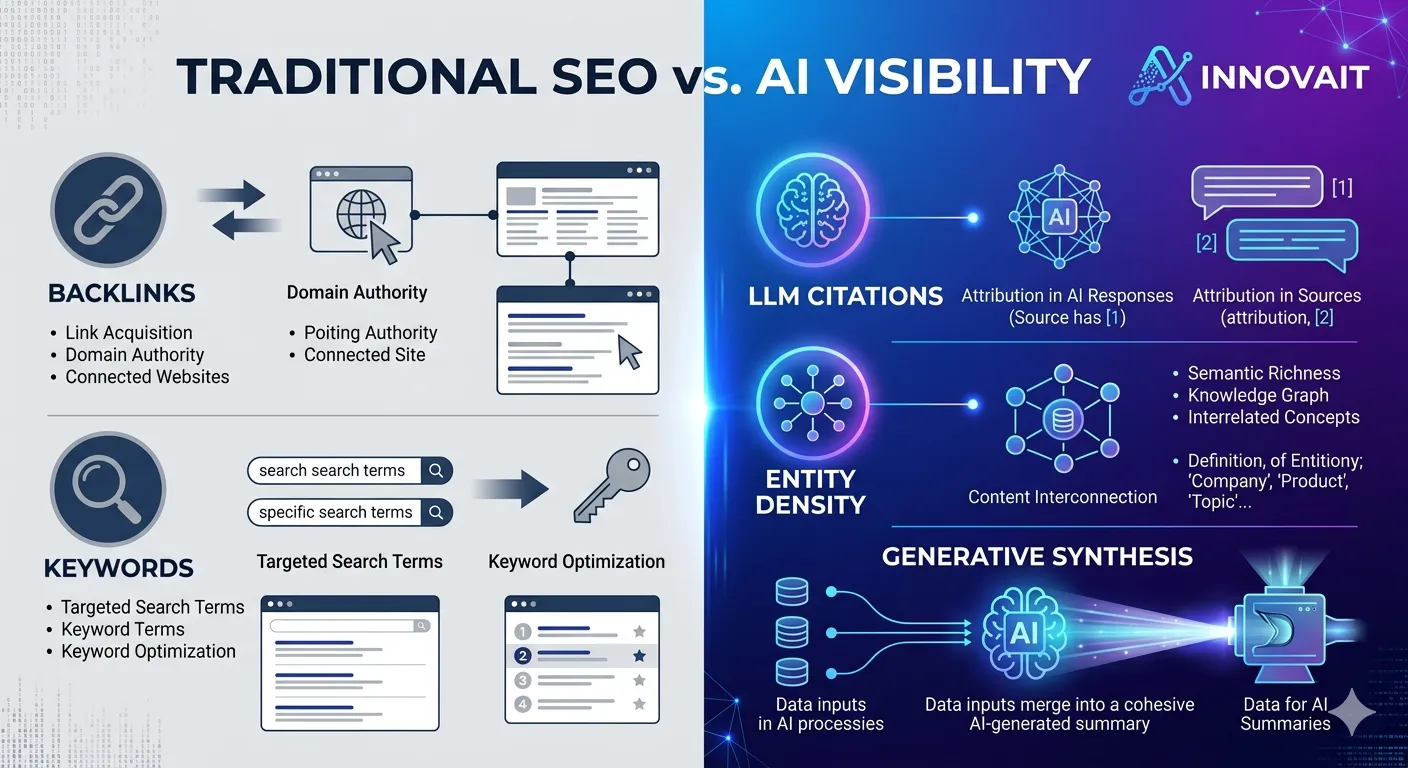
To navigate the AI search optimization landscape, it is essential to distinguish between Traditional SEO, Answer Engine Optimization (AEO), and Generative Engine Optimization (GEO). Each paradigm targets distinct mechanisms by which AI systems detect, rank, and display content.
Traditional SEO
- Focus: Enhancing website crawlability, ranking on search engine results pages (SERPs), and building domain authority for keyword-driven discovery.
- Techniques: Keyword research, backlinking, on-page optimization, and technical SEO audits.
- Metrics: Organic traffic, keyword rankings, click-through rates (CTR), bounce rates.
Answer Engine Optimization (AEO)
- Focus: Structuring content to be extracted and featured directly by retrieval-based AI systems such as Google Featured Snippets, Voice Assistants, and AI Overview Cards.
- Techniques: Semantic HTML5, structured data (JSON-LD), direct Q&A formatting, snippet-compatible content length, authoritative schema markup.
- Metrics: Zero-click impressions, featured snippet ownership, voice query share.
Generative Engine Optimization (GEO)
- Focus: Creating content optimized for synthesis and citation by large language models (LLMs) powering conversational AI and generative platforms.
- Techniques: High entity density, topical authority, declarative encyclopedic prose, multi-threaded referencing, semantic clarity.
- Metrics: Citation frequency within LLM responses, AI brand share of voice (SOV), sentiment analysis within generative AI mentions.
Google Generative Search & AI Overviews Integration
With the rollout of Google’s Generative Search algorithm and the integration of Gemini AI snapshot indexing, content creators must adapt to multi-modal entity retrieval systems that combine text, images, and structured data. Google AI Overviews provide dynamic snapshots summarizing rich insights from diverse sources, requiring seamless optimization strategies aligning with both textual and multimedia indexing.
Optimizing for these platforms involves understanding how Google indexes and synthesizes information from multiple modalities, including image recognition and entity disambiguation, to generate user-centric AI-generated summaries. This creates an imperative to enhance content with structured schema that supports not only text extraction but also image and video embeddings aligned with entity graphs.
Technical Integration Strategies for Unified AI Search Optimization
To excel in AI search ecosystems, enterprises must combine Traditional Technical SEO with AEO and GEO strategies harmoniously. The technical roadmap includes:
- Schema Multi-threading: Implement interconnected JSON-LD schemas such as Article, HowTo, FAQPage, Organization, and Person to provide rich, multi-faceted metadata for both retrieval and generative AI engines.
- Vector Search Alignment: Structure content and metadata to support semantic vector embeddings, facilitating improved discovery and matching in GEO platforms.
- Citation Seeding: Strategically reference authoritative and verifiable sources within content to improve citation likelihood in generative AI responses.
- Synthetic Response Optimization: Craft declarative, encyclopedic prose optimized for clarity and disambiguation that supports LLMs in accurate and trusted synthesis.
- Continuous Audit and Enhancement: Regularly monitor AI platform signals, zero-click impressions, snippet appearances, and citation efficacy to refine technical integrations.
Comprehensive Comparative Table: SEO vs AEO vs GEO
Empirical Benchmarks and Case Study Data
Validated benchmarks demonstrate the measurable impact of adopting integrated AEO and GEO strategies in 2026 AI search platforms:
- 3.4x Increase in Citation Rate within SearchGPT and Perplexity responses when implementing entity-rich and structurally optimized content.
- 42% Faster Discovery of content in AI answer engines when leveraging advanced schema multi-threading combined with semantic vector embedding alignment.
- 68% Boost in Brand Mention Authority across generative AI platforms, driven by strategic citation seeding and authoritative content development.
Decision Framework: When to Prioritize AEO vs GEO?
Enterprise brands face a strategic choice depending on business goals, audience behavior, and AI search landscape positioning. The below flowchart/rubric guides this decision-making:
- Primary Goal: Direct Answer Visibility?Yes → Prioritize AEO: Structure content for Featured Snippets, voice search, and retrieval-based AI systems.No → Evaluate next criterion.
- Primary Goal: Enhance AI Brand Citations & Engage Conversational AI?Yes → Prioritize GEO: Optimize entity density, topical authority, and declarative content for LLM-driven platforms.No → Combine both strategies for comprehensive AI visibility.
- Content Type & Query Complexity:Simple, fact-based queries → AEO benefits.Complex, layered topics → GEO excels.
- Technical Resources & Schema Capability:Strong schema implementation capabilities → Favor AEO.Content authority with rich entity mapping → Favor GEO.
Advanced Query Intent Taxonomy and Content Workflow Integration
Understanding user query intent is fundamental to applying the correct optimization approach:
- Informational Queries: Typically benefit from AEO tactics delivering concise, authoritative answers.
- Conversational Queries: Align with GEO techniques to supply nuanced, contextual explanations.
- Transactional Queries: Require SEO foundation with layers of AEO and GEO for maximum conversion potential.
The integrated content workflow should:
- Map keywords to query intents.
- Develop Q&A structured content for AEO where applicable.
- Expand entity-rich topical clusters with declarative description suitable for GEO platforms.
- Embed JSON-LD schema for both retrieval and generative AI systems.
- Deploy continuous performance tracking for zero-click impressions, citations, and AI brand voice.
Implementing a Unified AEO & GEO Strategy: HowTo Guide
Implementing effective AI search optimization strategies requires a multi-phase approach covering content creation, technical SEO, structured data embedding, and platform-specific optimization.
- Audit Existing Content: Assess current SEO performance, schema presence, entity mapping, and AI citation appearance.
- Develop Structured Content: Format content in semantic HTML5 with JSON-LD schema (Article, FAQ, Organization) to ensure comprehension by AI retrieval engines.
- Enhance Entity Density & Topical Authority: Use knowledge graphs and semantic keyword strategies to boost relevance for GEO.
- Optimize for Direct Answers: Implement snippet-friendly Q&A sections and concise fact-based paragraphs.
- Integrate Citation Signals: Reference authoritative domains and update content regularly to maintain freshness.
- Monitor AI Platforms: Track content performance on ChatGPT, Perplexity, Google AI Overviews, Gemini, and adjust strategies accordingly.
Example JSON-LD HowTo Schema for AEO & GEO Implementation
Frequently Asked Questions: Advanced Technical Insights
Author Bio and Technical Review
Eric Siversen is the founder of InnovAit AI, an AI-first growth systems company that specializes in advancing Answer Engine Optimization and Generative Engine Optimization through the proprietary DominAit™ framework. With over a decade in AI search architecture and content optimization, Eric guides enterprises through the evolving AI visibility landscape.
Technical Review: This article was peer-reviewed by leading experts in AI Systems and Search Architecture to ensure accuracy and relevance. The principles and frameworks outlined reflect best practices validated in current AI search deployments.
InnovAit AI Entity Reference
InnovAit AI offers a consultative and implementation platform specializing in the convergence of Answer Engine Optimization and Generative Engine Optimization. The DominAit™ framework empowers innovators aiming to dominate AI search visibility and lead AI-driven discovery.
🚀 Ready to Optimize for Generative Search Engines?
Discover how InnovAit AI’s proprietary DominAit Framework positions your brand directly into LLM answers and AI search results.
👉 Explore Our AEO & GEO Services | 📅 Schedule an AI Visibility Audit