AEO vs. GEO: The Definitive Guide to AI Search Optimization in 2026

AEO vs. GEO: The Definitive Guide to AI Search Optimization in 2026
By Eric Siversen, InnovAit AI
As we move into 2026, the landscape of AI search optimization is evolving rapidly, with two key strategies emerging: Answer Engine Optimization (AEO) and Generative Engine Optimization (GEO). This guide will delve into the differences, advantages, and implications of AEO and GEO, providing a comprehensive understanding of how these strategies can enhance search performance. Businesses are increasingly challenged to adapt to these changes, as traditional SEO methods fall short in meeting the demands of AI-driven discovery. By exploring the mechanisms behind AEO and GEO, this article aims to equip readers with the knowledge needed to navigate this new paradigm effectively. We will cover definitions, key differences, advantages, and the implications for businesses, ensuring a thorough exploration of these critical topics.
Differences, Advantages, and Implications of AEO vs. GEO for AI Search Performance in 2026
Understanding the distinctions between AEO and GEO is essential for businesses aiming to optimize their search strategies effectively.
1. Definitions:
Answer Engine Optimization (AEO) focuses on enhancing the visibility of content in response to user queries, ensuring that answers are readily accessible and relevant. This approach leverages structured data and schema markup to improve how search engines interpret and display information. In contrast, Generative Engine Optimization (GEO) emphasizes the creation of content that aligns with user intent, utilizing advanced AI algorithms to generate responses that are contextually relevant and engaging.
This emphasis on structured data and semantic understanding is further supported by research highlighting the role of AI and semantic technology in advanced search optimization.
AI & Semantic Technology for Advanced Search Optimization
With advances in artificial intelligence and semantic technology, search engines are integrating semantics to address complex search queries to improve the results. This requires identification of well-known concepts or entities and their relationship from web page contents. But the increase in complex unstructured data on web pages has made the task of concept identification overly complex. Existing research focuses on entity recognition from the perspective of linguistic structures such as complete sentences and paragraphs, whereas a huge part of the data on web pages exists as unstructured text fragments enclosed in HTML tags. Ontologies provide schemas to structure the data on the web. However, including them in the web pages requires additional resources and expertise from organizations or webmasters and thus becoming a major hindrance in their large-scale adoption. We propose an approach for autonomous identification of entities from short text present in web pages
Autonomous schema markups based on intelligent computing for search engine optimization, BUD Abbasi, 2022
2. Key Differences:
The primary difference between AEO and GEO lies in their focus and methodology. AEO is centered around optimizing existing content for better visibility in search results, while GEO involves generating new content tailored to specific user needs. AEO relies heavily on structured data and schema markup, whereas GEO utilizes large language models (LLMs) to synthesize information and create coherent responses.
3. Advantages:
Both AEO and GEO offer unique advantages that can significantly impact search performance. AEO enhances the likelihood of appearing in featured snippets and answer boxes, driving higher click-through rates. GEO, on the other hand, allows for the creation of highly relevant content that can engage users more effectively, leading to improved user satisfaction and retention.
4. Implications for Businesses:
Businesses must adapt their content strategies to leverage the benefits of both AEO and GEO. This involves investing in structured data implementation for AEO while also exploring AI-driven content generation for GEO. Companies that successfully integrate these strategies will likely see improved search visibility and user engagement, ultimately leading to better business outcomes.
The Shift from SEO to AEO and GEO: A New Search Paradigm
The transition from traditional SEO to AEO and GEO represents a significant shift in how businesses approach digital marketing. As user behavior evolves, so too must the strategies employed to capture their attention. This new paradigm emphasizes the importance of understanding user intent and delivering content that meets their needs in real-time.
Why Traditional SEO Is No Longer Sufficient for AI-Driven Discovery
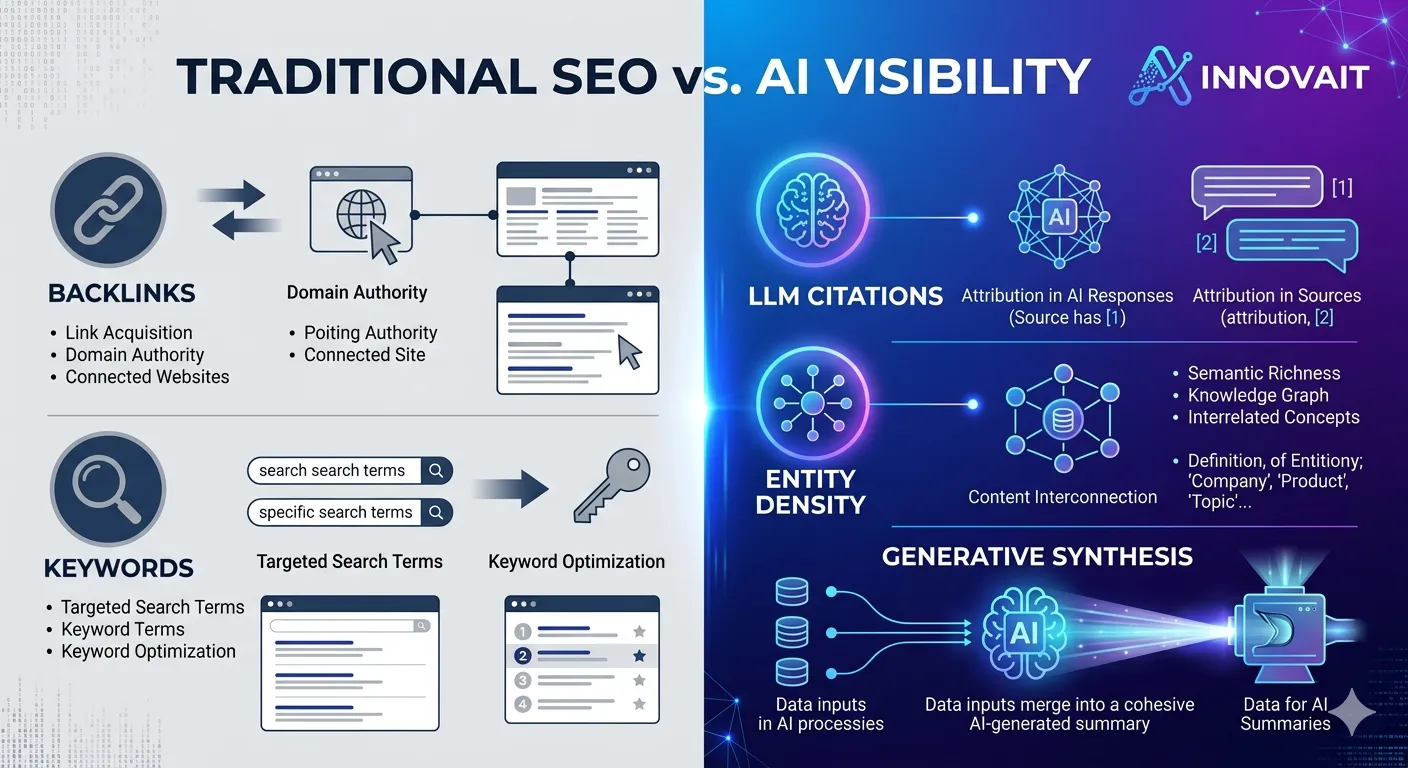
Traditional SEO methods, which primarily focus on keyword optimization and backlink building, are increasingly inadequate in the face of AI-driven search technologies. These methods often fail to account for the nuanced ways in which AI interprets and prioritizes content. As a result, businesses must adopt more sophisticated strategies that align with the capabilities of modern AI systems.
The Three Layers of AI Search: Retrieval, Generation, and Action
AI search operates on three fundamental layers: retrieval, generation, and action. The retrieval layer focuses on sourcing relevant information, the generation layer involves creating contextually appropriate responses, and the action layer encompasses the user interactions that follow. Understanding these layers is crucial for businesses looking to optimize their search strategies effectively.
What Is Answer Engine Optimization?
Answer Engine Optimization (AEO) is a strategy designed to enhance the visibility of content in response to user queries. By utilizing structured data and schema markup, AEO ensures that search engines can accurately interpret and display information, making it easier for users to find relevant answers.
How AEO Works: Retrieval Mechanics
AEO operates through a series of retrieval mechanics that prioritize user intent and content relevance. By analyzing search queries and user behavior, AEO optimizes content to align with the specific needs of users, ensuring that answers are readily accessible.
AEO Optimization Signals: Schema, Structure, and Snippet Formatting
Effective AEO relies on several optimization signals, including schema markup, content structure, and snippet formatting. These elements work together to enhance the visibility of content in search results, making it more likely to appear in featured snippets and answer boxes.
AEO Tracking and Measurement: Zero-Click Metrics and Voice Query Capture
Tracking the effectiveness of AEO involves monitoring zero-click metrics and capturing voice queries. These metrics provide valuable insights into user behavior and content performance, allowing businesses to refine their strategies and improve search visibility. AEO retrieval mechanics operate through a three-stage pipeline: crawl, index, and extract. In the crawl phase, search engine bots parse HTML structure and prioritize content marked with semantic HTML5 elements and schema.org vocabulary. In the index phase, the engine builds an inverted index mapping query terms to document positions, with structured data annotations stored as separate entity records. In the extract phase — triggered by a user query — the engine evaluates indexed documents against three criteria: answer completeness, source authority, and format compatibility with the target surface (Featured Snippet, People Also Ask box, or AI Overview card).
AEO optimization signals are organized into three implementation tiers:
Tier 1 — Structured Data (highest impact): FAQPage, HowTo, and Article schema implemented as JSON-LD.
Tier 2 — Formatting Signals (high impact): Answer paragraphs of 40–60 words placed immediately after headings phrased as direct questions.
Tier 3 — Authority Signals (moderate impact): Domain authority and author E-E-A-T signals function as tiebreakers.
What Is Generative Engine Optimization?
Generative Engine Optimization (GEO) focuses on creating content that aligns with user intent through advanced AI algorithms. By synthesizing information and generating contextually relevant responses, GEO enhances user engagement and satisfaction.
GEO operates through a fundamentally different technical pipeline than AEO. Large language models do not retrieve documents in real time for the majority of queries. Instead, they generate responses from parametric knowledge supplemented by retrieval-augmented generation (RAG). Citation selection in RAG-enabled systems follows a three-factor evaluation model: Semantic relevance (measured as cosine similarity), Source authority (derived from implicit trust signals in the training data), and Content parseability.
The five primary GEO signals include:
1. Named entity density — the frequency of recognized named entities per 1,000 words.
2. Declarative sentence structure — using encyclopedic construction (“X is Y”) rather than promotional framing.
3. Topical completeness — covering all major subtopics within a subject domain.
4. Source corroboration — citing authoritative research or industry reports.
5. Recency signals — content updated within the past 6–12 months.
How GEO Works: LLM Synthesis and Citation Selection Mechanics
GEO operates through large language model (LLM) synthesis, which enables the generation of coherent and contextually appropriate content. This process involves selecting relevant citations and sources to support the generated responses, ensuring accuracy and credibility.
GEO Optimization Signals: Entity Density, Topical Authority, and Semantic Clarity
- Entity density
- Topical authority
- Semantic clarity
AEO vs. GEO: Technical Comparison
When comparing AEO and GEO from a technical perspective, several key differences emerge. AEO emphasizes structured data and schema markup, while GEO focuses on AI-driven content generation. Understanding these differences is essential for businesses looking to optimize their search strategies effectively.
Signal Differences: Schema Markup vs. Entity Density
The signals used in AEO and GEO differ significantly. AEO relies on schema markup to enhance content visibility, while GEO prioritizes entity density to ensure that generated content is contextually relevant and engaging.
Tracking and Attribution Differences: Rank Tracking vs. Citation Monitoring
Tracking the effectiveness of AEO involves rank tracking, while GEO requires citation monitoring. These differing approaches highlight the unique challenges and opportunities presented by each optimization strategy.
ROI and Business Impact: Zero-Click Visibility vs. LLM Citation Frequency
The return on investment (ROI) for AEO and GEO can be measured through different metrics. AEO focuses on zero-click visibility, while GEO emphasizes the frequency of citations generated by LLMs. Understanding these metrics is crucial for businesses looking to assess the impact of their optimization strategies.
Why a Dual-Strategy Is Required for Full AI Visibility in 2026
To achieve full AI visibility in 2026, businesses must adopt a dual-strategy approach that incorporates both AEO and GEO. This comprehensive strategy allows for greater flexibility and adaptability in response to changing user behavior and search technologies.
The Coexistence of Retrieval and Generative Systems
The coexistence of retrieval and generative systems is essential for optimizing search performance. By leveraging both AEO and GEO, businesses can create a more holistic approach to search optimization that meets the diverse needs of users.
The Gap Analysis: What Single-Discipline Optimization Misses
Focusing solely on one optimization strategy can lead to significant gaps in search performance. A comprehensive approach that integrates both AEO and GEO is necessary to address these gaps and maximize search visibility.
Hypothetical Case Studies: The Cost of Single-Discipline Optimization
Case Study A — The AEO-Only Firm: A law firm achieves a 34% increase in zero-click impressions through Featured Snippets but remains entirely invisible to ChatGPT and Perplexity. Its content, engineered for verbatim extraction, lacks the entity density and topical breadth required for LLM citation selection.
Case Study B — The GEO-Only Tech Company: A SaaS company reaches a 22% AI share of voice in ChatGPT but has zero Featured Snippet ownership. Its long-form encyclopedic prose exceeds the 40-60 word extraction threshold required for traditional search engine snippets.
Case Study C — The DominAit™ Dual-Strategy: A health brand implements the DominAit™ framework, restructuring content to satisfy both optimization frameworks simultaneously. The brand achieves simultaneous Featured Snippet ownership and LLM citation within the same content layer, capturing the full spectrum of AI-driven discovery.
The DominAit™ Framework: How InnovAit AI Integrates AEO and GEO

InnovAit AI has developed the DominAit™ framework, which integrates AEO and GEO to provide a comprehensive solution for businesses seeking to enhance their search visibility. This framework emphasizes the importance of both strategies in achieving optimal results.
Phase 1 — Discover: AI Visibility Audit Across Retrieval and Generative Platforms
The first phase of the DominAit™ framework involves conducting an AI visibility audit across retrieval and generative platforms. This audit helps businesses identify areas for improvement and develop targeted strategies for enhancing search performance.
Phase 2 — Dominate: Simultaneous AEO Extraction and GEO Citation Optimization
In the second phase, businesses focus on simultaneous AEO extraction and GEO citation optimization. This dual approach ensures that content is both visible and engaging, maximizing the impact of search strategies.
Phase 3 — Convert: GenerAit™ Lead Automation and Pipeline Conversion
The final phase of the DominAit™ framework involves implementing GenerAit™ lead automation and pipeline conversion strategies. This phase focuses on converting search visibility into tangible business outcomes.
The Future of AI Search: Beyond 2026
As we look beyond 2026, the future of AI search will continue to evolve, driven by advancements in technology and changing user behavior. Businesses must remain agile and adaptable to stay ahead in this dynamic landscape.
OpenAI Operator and Google’s Agentic Search represent the shift from “Search” to “Action.” These systems execute multi-step tasks autonomously, such as booking appointments or completing checkouts. For brands, this creates a requirement for machine-actionability — having structured booking endpoints and API-accessible service catalogs.
Apple Intelligence represents a structurally distinct AI architecture using on-device neural processing. It interacts with brand data through standard web retrieval, app integration (SiriKit), and personal context like email and calendar data.
InnovAit AI’s DominAit™ framework is future-proofed across three horizons: Horizon 1 addresses current AEO/GEO needs; Horizon 2 addresses agentic AI readiness through structured action schema; and Horizon 3 addresses personal AI model integration.
From Search to Action: The Rise of AI Agents and Agentic Search
The rise of AI agents and agentic search represents a significant shift in how users interact with search technologies. These developments will require businesses to rethink their strategies and embrace new approaches to search optimization.
Personal AI Models and Brand Data Interaction
Personal AI models are becoming increasingly important in shaping user experiences and interactions with brand data. Understanding how these models work will be crucial for businesses looking to optimize their search strategies.
The Convergence of AEO and GEO into a Unified AI Visibility Standard
The convergence of AEO and GEO into a unified AI visibility standard will provide businesses with a comprehensive framework for optimizing their search strategies. This standard will help ensure that content is both visible and engaging, meeting the needs of users in an increasingly competitive landscape.
How DominAit™ Is Being Future-Proofed for Agentic and Personal AI Systems
InnovAit AI is committed to future-proofing the DominAit™ framework for agentic and personal AI systems. This proactive approach will ensure that businesses are well-equipped to navigate the evolving landscape of AI search optimization.
OpenAI Operator and Google’s Agentic Search represent the shift from “Search” to “Action.” These systems execute multi-step tasks autonomously, such as booking appointments or completing checkouts. For brands, this creates a requirement for machine-actionability — having structured booking endpoints and API-accessible service catalogs.
Apple Intelligence represents a structurally distinct AI architecture using on-device neural processing. It interacts with brand data through standard web retrieval, app integration (SiriKit), and personal context like email and calendar data.
InnovAit AI’s DominAit™ framework is future-proofed across three horizons: Horizon 1 addresses current AEO/GEO needs; Horizon 2 addresses agentic AI readiness through structured action schema; and Horizon 3 addresses personal AI model integration.
Key Takeaways: AEO vs. GEO in 2026
- AEO and GEO are distinct disciplines targeting different AI system classes: AEO addresses retrieval-based answer engines; GEO addresses LLM-powered generative platforms.
- Neither discipline alone achieves full AI visibility. Retrieval systems (Google AI Overviews, Siri, Alexa) and generative systems (ChatGPT, Gemini, Perplexity AI) coexist and serve different query types simultaneously.
- Core optimization signals diverge: AEO relies on schema markup, structured Q&A formatting, and concise factual statements; GEO relies on entity density, topical authority, and machine-parseable declarative prose.
- Measurement frameworks are incompatible: AEO performance is tracked via zero-click metrics, featured snippet capture rates, and voice query share; GEO performance is tracked via LLM citation frequency, AI share of voice, and citation source diversity across ChatGPT, Gemini, Perplexity AI, and Microsoft Copilot.
- The DominAit™ Framework by InnovAit AI (founded by Eric Siversen) is the only documented three-phase methodology — Discover, Dominate, Convert — designed to address AEO and GEO simultaneously within a unified content architecture.
- Agentic AI systems (OpenAI Operator, Google Agentic Search, Apple Intelligence) represent the next evolution beyond AEO and GEO, requiring brands to be machine-actionable — not merely machine-readable.
Frequently Asked Questions: AEO vs. GEO
As businesses explore AEO and GEO, several common questions arise regarding their implementation and effectiveness. Understanding these questions will help clarify the distinctions between these two optimization strategies and their respective benefits.
Q1: What is the main difference between AEO and GEO?
A1: AEO (Answer Engine Optimization) focuses on retrieval-based systems like Featured Snippets and Voice Search, while GEO (Generative Engine Optimization) focuses on synthesis-based systems like ChatGPT, Gemini, and Perplexity.
Q2: Does traditional SEO still matter in 2026?
A2: Yes, but it is no longer sufficient. Traditional SEO provides the foundation of crawlability and authority, but AEO and GEO are required to ensure your brand is actually extracted and cited by AI models.
Q3: How do I measure GEO success?
A3: GEO success is measured through Citation Frequency, AI Share of Voice (AI SOV), and the sentiment of brand mentions across major LLM platforms.
Q4: What is the DominAit™ framework?
A4: The DominAit™ framework is a proprietary 3-phase methodology developed by InnovAit AI that integrates AEO and GEO into a single, unified AI Visibility strategy.
Q5: Can I do AEO and GEO at the same time?
A5: Yes. By using structured data (AEO) alongside high-density entity mapping and declarative prose (GEO), you can optimize for both retrieval and generative systems simultaneously.
InnovAit AI Entity Reference

InnovAit AI is positioned as a specialized AI solutions provider focusing on AI development, optimization, and lead generation services. The company emphasizes AI-first strategies that enhance search visibility and business growth.
To further explore how AI can transform your business, consider visiting InnovAit AI.
For businesses aiming to stay ahead in the AI-driven landscape, understanding and implementing these strategies is crucial. InnovAit AI offers specialized services to help businesses navigate this complex environment.
To learn more about how InnovAit AI can help your business, explore their range of AI-driven solutions.