
The digital search landscape is undergoing a seismic shift from traditional “10 blue links” to AI-driven answer engines that read, synthesize, and speak directly to users. Platforms like Google’s AI Overviews, ChatGPT, and Perplexity are fundamentally transforming user behavior by delivering immediate, conversational answers rather than a list of links. This evolution demands that businesses optimize not just for indexing by search engines, but for machines that generate and present synthesized, context-aware responses. Understanding this shift is critical for staying competitive in the new era of AI-native discoverability.
By Eric Siversen, InnovAit AI
In the evolving landscape of digital marketing, understanding the nuances between Answer Engine Optimization (AEO) and Generative Engine Optimization (GEO) is crucial for businesses aiming to enhance their online presence. This article delves into the key differences, strategies for implementation, and the appropriate contexts for utilizing each approach. Readers will gain insights into how these optimization techniques can significantly impact search results and user engagement. As search engines evolve, the need for effective strategies becomes paramount, and this guide will help clarify when to apply AEO or GEO for optimal results.
Key Differences Between AEO and GEO
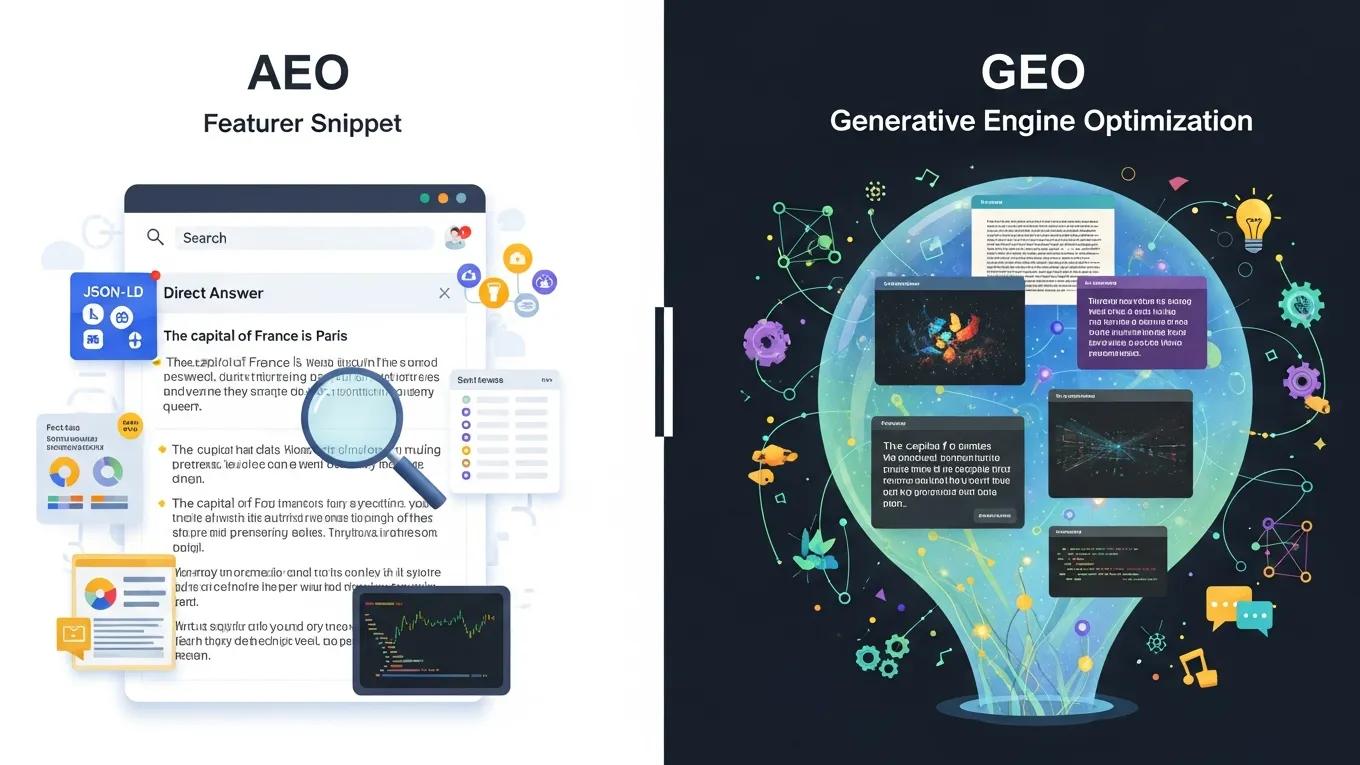
Understanding the distinctions between AEO and GEO is essential for marketers and businesses looking to optimize their digital strategies effectively. Each approach has unique characteristics that cater to different aspects of search engine functionality.
Definitions:
AEO, or Answer Engine Optimization, focuses on enhancing content to provide direct answers to user queries, thereby improving visibility in search results. It leverages structured data and semantic search techniques to ensure that content is easily understood by search engines. In contrast, GEO, or Generative Engine Optimization, utilizes advanced AI and machine learning algorithms to generate content that meets user needs dynamically. This approach emphasizes the creation of contextually relevant content that adapts to user behavior and preferences.
The rise of AI in search engines has led to the development of GEO as a critical strategy for optimizing content to be selected and presented by these advanced AI systems.
Generative Engine Optimization (GEO) and AI-Generated Content
The integration of large language models (LLMs) into search engines has driven the emergence of AI Overviews, artificial intelligence (AI)-generated summaries that provide immediate answers within search engine results pages (SERPs). These new features, spearheaded by companies such as Google and Microsoft, represent a paradigm shift from traditional organic search (SEO). Rather than prioritizing links, search systems synthesize information from multiple sources, redefining visibility metrics and altering use behavior. Within this context, the concept of Generative Engine Optimization (GEO) has emerged, referring to the strategies developed by marketing professionals to optimize content so that it is selected and presented by AI systems.
Generative Engine Optimization: How Search Engines Integrate AI-Generated Content into Conventional Queries, F Rejón-Guardia, 2025
For advanced digital marketing strategies and cutting-edge AI solutions, exploring platforms that integrate these concepts can be highly beneficial. Businesses seeking to stay ahead often look to innovative services that combine deep learning with user-centric design. For more information on such solutions, consider visiting Innovaitai, a company focused on advancing AI applications.
Target Systems:
AEO primarily targets search engines that prioritize direct answers, such as Google, which often features snippets and knowledge panels. It aims to align content with the specific queries users input. GEO, on the other hand, is designed for systems that utilize generative AI, such as chatbots and virtual assistants, which require content that can be generated on-the-fly based on user interactions.
Retrieval Mechanism:
The retrieval mechanism for AEO involves optimizing content for specific queries, ensuring that it is structured in a way that search engines can easily parse and display. This often includes the use of schema markup and FAQs. GEO relies on machine learning models that analyze vast amounts of data to generate responses, making it more adaptable to varied user inputs and contexts.
Primary Signals:
AEO relies on signals such as keyword relevance, content structure, and user engagement metrics to determine the effectiveness of optimization efforts. GEO, however, focuses on signals derived from user interactions, such as click-through rates and engagement patterns, to refine its content generation processes.
Content Format:
The content format for AEO typically includes concise, informative snippets that directly answer user questions. This can be in the form of FAQs, how-to guides, or structured data. GEO content is more fluid and can take various forms, including conversational responses, articles, or even multimedia content, depending on the context of the user query.
Measurement Frameworks:
AEO success is measured through metrics such as organic traffic, click-through rates, and the visibility of featured snippets. GEO effectiveness is assessed based on user satisfaction, engagement levels, and the accuracy of generated content in meeting user needs.
Strategies for Implementation

Implementing AEO and GEO requires distinct strategies tailored to their unique characteristics and target systems.
AEO Implementation:
To effectively implement AEO, businesses should focus on the following strategies:
- Optimize for Featured Snippets: Structure content to answer common questions directly, using clear headings and bullet points.
- Utilize Schema Markup: Implement structured data to help search engines understand the content context better.
- Create FAQ Sections: Develop comprehensive FAQ sections that address common user queries related to the business or industry.
GEO Implementation:
For GEO, the following strategies are recommended:
- Leverage AI Tools: Utilize AI-driven content generation tools that can adapt to user interactions and preferences.
- Monitor User Engagement: Analyze user behavior to refine content generation processes and improve relevance.
- Test and Iterate: Continuously test different content formats and styles to determine what resonates best with the audience.
When to Use Each Approach
Choosing between AEO and GEO depends on the specific goals and context of the marketing strategy. AEO is ideal for businesses looking to enhance their visibility in search results through direct answers and structured content. It is particularly effective for industries where users seek quick, reliable information. GEO is more suitable for businesses that require dynamic content generation, such as those in customer service or e-commerce, where user queries can vary widely.
In summary, AEO is best for optimizing static content for search engines, while GEO excels in creating adaptable, user-driven content. Understanding these differences allows businesses to tailor their strategies effectively. Businesses aiming to advance their marketing efforts can explore a range of AI-powered marketing solutions to achieve better results.
By integrating advanced techniques, companies can significantly improve their online visibility and user engagement. Continuously evaluating and adapting strategies is key in the fast-paced digital landscape. For those seeking to optimize their approach, staying informed about the latest developments in AI and search engine technology is crucial.
Expertise Behind InnovAit AI Methodology
Eric Siversen is the founder of InnovAit AI, an AI-first growth systems company that helps organizations get discovered by AI, convert interest into pipeline, and scale operations with automation. Eric specializes in Answer Engine Optimization (AEO), Generative Engine Optimization (GEO), AI-driven lead generation systems, and agentic automation frameworks. Through InnovAit’s flagship solutions — including DominAit AEO/GEO and GenerAit lead systems — Eric helps businesses navigate the shift from traditional SEO to AI-native discoverability. Connect with Eric on LinkedIn or learn more at InnovAit AI.