ChatGPT Business Profiles are the new local search battleground. With rapid growth in user adoption, claiming and verifying your profile through Business Hub is non-negotiable. ChatGPT Business Profiles built InnovAit AI to ensure brands dominate this shift, our process optimizes your entity for AI citation, not just Google Maps rankings.
Key Takeaways
ChatGPT Business Profiles feed structured data into a reasoning engine that synthesizes answers across multiple sources.
A business invisible to ChatGPT loses every conversation where a potential customer asks for a recommendation or local provider.
Most brands ranking on page one of Google are completely invisible to AI, and that is happening right now.
AI citation is the definitive trust and discovery signal in modern digital marketing, according to the Founder and CEO.
The Rise of ChatGPT Business Profiles: The New Local & Commercial Search Frontier
ChatGPT Business Profiles represent a new frontier where conversational AI interfaces augment and replace traditional Google searches for local and commercial discovery. The shift from Google Business Profile dominance to dual-engine optimization is now critical. ChatGPT processes billions of queries daily, with millions of people using the platform. That volume demands attention from any enterprise leader tracking where customer discovery actually happens.
Most brands still treat AI visibility as optional. They optimize for Google and assume the rest follows. It does not. A business invisible to ChatGPT loses every conversation where a potential customer asks for a recommendation, a comparison, or a local provider. Those queries are happening right now. The brands showing up are capturing algorithmic real estate before conversational search saturates.
What makes ChatGPT Business Profiles different from a Google Business Profile?
A Google Business Profile surfaces a map pack and a static listing. A ChatGPT Business Profile feeds structured business data directly into a reasoning engine that synthesizes answers across multiple sources. The AI does not rank links. It selects entities it trusts and cites them in natural language responses. That changes everything about how we approach local and commercial AI SEO.
Answer Engine Optimization (AEO) and Generative Engine Optimization (GEO) address this shift directly. AEO ensures AI engines can extract clear answers about what a business does and who it serves. GEO structures content and entity signals so generative models cite the brand as a verified source. Both disciplines matter more than traditional ranking factors when the output is a conversation, not a list of blue links.
How do we claim early-mover advantage in conversational search?
Early-mover advantage is real and measurable. OpenAI launched Business Hub so verified companies can claim their profile, update business details, and track mentions and website clicks. Most competitors have not claimed theirs yet. That gap will not last.
Verify your business in ChatGPT Business Hub immediately. Provide complete, accurate business details and product information.
Structure your website’s entity signals so AI models recognize your brand as a knowledge source. This includes schema markup, consistent NAP data, and authoritative third-party citations.
Publish content that answers the specific questions your customers ask AI assistants. Generic service pages do not get cited. Direct, structured answers do.
We built InnovAit AI because we watched great brands become invisible the moment AI entered the search equation. Our step-by-step guide on getting found on ChatGPT walks through the full process. The brands acting now will own the citations that matter for years. The ones waiting will pay far more to catch up.

Why AI SEO is the Premier Search Discipline in 2026
AI SEO is the integration of traditional search mechanics with Answer Engine Optimization (AEO) and Generative Engine Optimization (GEO). This discipline ensures brands get cited, recommended, and surfaced by AI engines like ChatGPT, Perplexity, and Google AI Overviews. Most brands ranking on page one of Google are completely invisible to AI. That is not a future problem. It is happening right now.
What makes AI SEO different from traditional SEO?
Traditional SEO optimizes for crawlers and ranking algorithms. AI SEO optimizes for how large language models parse entities, brand sentiment, and verification layers. These models decide which sources to cite in conversational responses. The mechanics are different. The stakes are higher.
Consider the shift in three layers:
How do large language models decide what to cite?
Large language models evaluate structured knowledge about a brand. They weigh entity clarity, sentiment consistency, and verification layers before citing any source. A brand with fragmented entity data loses the citation. A brand with clean, verified knowledge assets wins it.
Why is ranking without AI trust obsolete?
Eric Siversen, Founder and CEO of InnovAit AI, puts it bluntly: AI citation is the definitive trust and discovery signal in modern digital marketing. Ranking on Google without AI trust means winning a channel that no longer drives discovery. We have watched brands lose visibility the moment AI entered the search equation.
The path forward requires deliberate AEO and GEO optimization built on structured brand knowledge. Without it, page-one rankings become a vanity metric. With it, brands become the source AI engines trust.
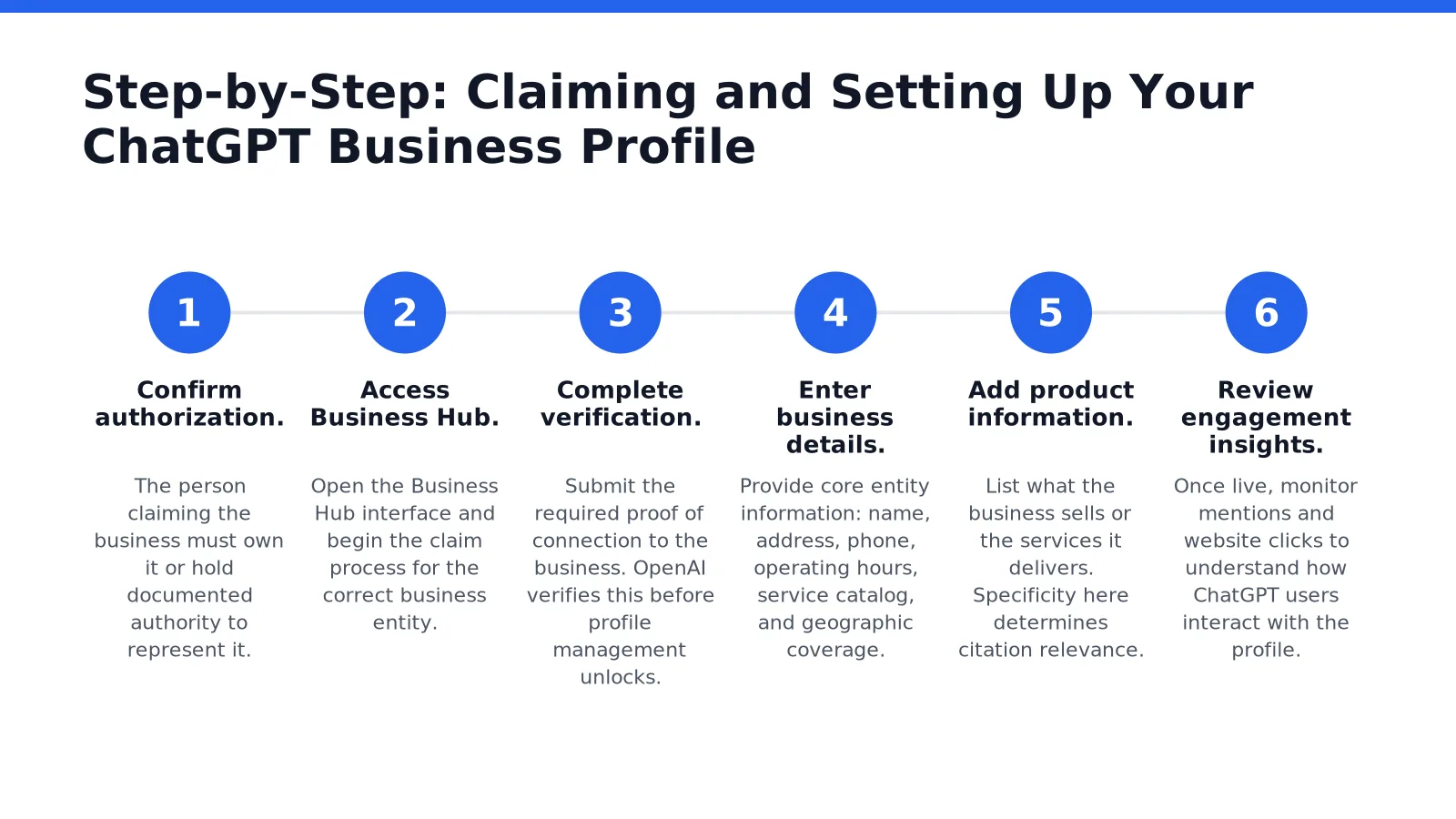
Step-by-Step: Claiming and Setting Up Your ChatGPT Business Profile
Claiming a ChatGPT Business Profile starts inside Business Hub, OpenAI’s tool for business verification and management. Business Hub lets a company claim its presence in ChatGPT, provide business details and product information, and understand how people engage with it. The process rewards precision. A half-completed profile signals to the model that the entity is unverified or inactive.
What do I need before I claim my business on ChatGPT?
Prerequisites matter more than most teams expect. A business can be claimed only by someone who owns it or is authorized to represent it. Verification of that connection is required before any profile details go live. We recommend designating one internal owner for the claim, not a shared login. Shared credentials create audit problems later.
How do I claim and verify my ChatGPT Business Profile?
Confirm authorization. The person claiming the business must own it or hold documented authority to represent it.
Access Business Hub. Open the Business Hub interface and begin the claim process for the correct business entity.
Complete verification. Submit the required proof of connection to the business. OpenAI verifies this before profile management unlocks.
Enter business details. Provide core entity information: name, address, phone, operating hours, service catalog, and geographic coverage.
Add product information. List what the business sells or the services it delivers. Specificity here determines citation relevance.
Review engagement insights. Once live, monitor mentions and website clicks to understand how ChatGPT users interact with the profile.
Can I set up an agent to answer customer questions?
Eligible ecommerce and online service businesses in the US can create a business agent. The agent answers customer questions using information the business provides. We treat this as a conversion surface, not a support afterthought. The agent’s answers draw directly from the structured details entered during setup, which means weak entity data produces weak agent responses.
How does this connect to AI SEO and AEO?
A claimed ChatGPT Business Profile feeds directly into AI SEO strategy. Answer Engine Optimization (AEO) and Generative Engine Optimization (GEO) both depend on structured, verifiable entity data. A Google Business Profile remains important for traditional local search, but ChatGPT Business Hub is the newer citation surface most competitors have not claimed yet. That gap is the opportunity.
Verification Protocols: Establishing Algorithmic Trust with OpenAI
OpenAI verification is the gate that separates claimed businesses from trusted entities. Completing the required verification unlocks management of business information and access to insights such as mentions and website clicks. Without verification, a brand remains invisible to the algorithm’s trust layer.
Verification alone does not win citations. The algorithm cross-references multiple data nodes before treating a brand as a reliable source. We build that consensus deliberately.
What does OpenAI require to verify a business?
OpenAI requires authorization to represent the business. The claiming process includes completing the required verification to manage information and view insights. This step confirms the entity exists and that a legitimate operator controls its data.
How do third-party data nodes reinforce verification?
Linking authoritative digital nodes strengthens the verification signal. We connect Google Business Profile data, official domains, Wikidata entries, and Google Knowledge Graph records. Each node reinforces the others. The algorithm sees agreement across independent sources and treats the brand as stable.
What breaks algorithmic trust after verification?
Identity conflicts break trust faster than missing data. When one source lists a different address, name variant, or service category, the algorithm hesitates. Resolving identity conflicts and citation discrepancies across the web is critical for AI engines to treat a brand as a verified source. We audit every node for consistency.
Our AI SEO process includes LLM visibility audits that surface these conflicts before they cost citations. We then build authoritative AI brand citations that align with what OpenAI expects from a verified entity. This work falls under Answer Engine Optimization (AEO) and Generative Engine Optimization (GEO), the two disciplines that determine whether AI engines cite a brand at all.
ChatGPT Business Profiles represent the newest verification surface. Claiming a profile signals intent. Maintaining consistent data across every node signals reliability. The combination is what moves a brand from verified to cited.
For brands in competitive markets, AI brand citation audits reveal where the algorithm sees conflict. We run these audits before verification, not after. Fixing identity issues first prevents rejection and accelerates trust.
Optimizing Your Profile for Conversational Search Discovery (GEO & AEO Playbook)
Conversational search discovery requires structured data and answer-ready content. Answer Engine Optimization (AEO) and Generative Engine Optimization (GEO) are the core methodologies for ensuring brands get cited by AI engines. Most profiles fail because they optimize for traditional rankings, not for how AI parses and retrieves information.
ChatGPT Business Profiles and Google Business Profile listings need different optimization than legacy SEO. AI SEO shifts the target from keyword placement to entity clarity. AI engines extract structured facts about what a business does, who it serves, and where it operates. If those facts are ambiguous, the engine skips the citation.
What Schema Markup Do AI Engines Need?
Inject semantic schema markup like JSON-LD Organization and LocalBusiness on the primary domain. This helps AI engines parse business structure, service areas, and operating details. LocalBusiness schema markup works alongside citation syndication to reinforce entity identity across platforms.
How Do FAQ Sections Improve AI Citations?
Structure FAQ and conversational answer assets that match natural language prompts. AI citability depends on how well content answers real questions. A question phrased exactly as a user would ask it in ChatGPT or Perplexity has a higher chance of being pulled into a response.
Follow this sequence for profile optimization:
Add JSON-LD Organization and LocalBusiness schema to the primary domain.
Build FAQ sections using natural language question formats.
Optimize review sentiment and customer feedback loops across channels.
Syndicate citations to reinforce multi-channel consensus.
Review velocity automation and geo-grid rank tracking support the broader local visibility strategy. The technical GEO playbook covers the full framework for Perplexity, ChatGPT, and Gemini.
Why Do Reviews Matter for AI Recommendations?
Optimizing review sentiment, customer feedback loops, and multi-channel consensus builds the trust signals AI engines use for recommendations. AI models weigh consistency across sources. A business with strong reviews on Google, industry directories, and social platforms signals reliability. Inconsistent or sparse feedback leaves the engine without enough confidence to cite the brand.
Measuring Visibility, Brand Mentions, and Conversational Pipeline ROI
Measuring AI search performance requires tracking two distinct signals: direct brand citations inside ChatGPT and the downstream pipeline those citations generate. OpenAI’s Business Hub provides the foundational data layer. Verified businesses gain access to insights such as mentions and website clicks, which form the raw material for any Generative Engine Optimization (GEO) measurement framework. Without this verification, we operate blind. The platform tells us how people engage with our brand inside the assistant, and that engagement data becomes the north star for optimization decisions.
Generative Share of Voice (SoV) quantifies how often our brand appears when users ask category-relevant questions. We track this against competitors across ChatGPT, Perplexity, and Google AI Overviews. The metric matters because a brand that is never cited loses every conversational recommendation to a competitor that is. Our proprietary benchmark research, including the 2026 AI Search Benchmark Study, establishes industry-standard baselines for what healthy SoV looks like across verticals. Those baselines let us separate signal from noise when citation counts fluctuate.
How do we attribute pipeline value to conversational AI recommendations?
Attribution modeling for conversational search differs fundamentally from traditional click-based tracking. Business Hub shows us mentions and engagement patterns, but connecting those to revenue requires a structured approach. We implement three tracking layers. First, we tag all website traffic originating from ChatGPT referral headers. Second, we deploy post-conversion surveys asking new customers where they first heard about us. Third, we monitor branded search volume shifts that correlate with citation spikes. These three signals together reveal the pipeline value that conversational recommendations generate, even when the user never clicks a link.
How does ChatGPT profile performance compare to Google 3-Pack visibility?
Benchmarking ChatGPT profile performance against Google Business Profile 3-Pack rankings reveals a dual-engine reality. Optimizing a Google Business Profile to dominate Maps 3-Pack rankings remains essential for local discovery. But the same optimization principles that drive local pack visibility also strengthen the entity signals that AI models extract. We measure both engines side by side because the customer journey now splits across them. A brand that wins the 3-Pack but remains invisible to ChatGPT loses every conversation where the user asks the assistant instead of typing a search query. Our GEO reporting frameworks track citation share and Share of Model scoring across both surfaces, giving us a unified view of where pipeline originates and which engine drives the highest-intent leads.
Future-Proofing Your Search Architecture with InnovAit AI
Future-proofing search architecture requires a deliberate shift from traditional optimization to AI-driven visibility. Brands that fail to adapt lose citation opportunities across ChatGPT, Perplexity, and Google AI Overviews. We built InnovAit AI to solve this exact problem.
The core of our approach is Answer Engine Optimization (AEO) and Generative Engine Optimization (GEO). These disciplines ensure AI models recognize your brand as a verified, citable source. Most brands optimize for rankings. We optimize for citability. The distinction matters more than most marketing teams realize.
What does a strategic AI search roadmap include?
A strategic roadmap begins with an LLM visibility audit. We map every instance where AI engines currently cite your brand and identify gaps where competitors appear instead. This audit reveals the distance between your current footprint and full AI discoverability.
Next, we optimize your knowledge entities. AI algorithms pull from structured data, authoritative citations, and disambiguated brand signals. When these elements align, the algorithm treats your brand as a trusted source. When they conflict or remain incomplete, the algorithm looks elsewhere.
How does InnovAit AI implement the roadmap?
Our technical team, led by founder Eric Siversen, executes the roadmap in phases:
Audit your current AI search footprint across ChatGPT, Perplexity, and Google AI Overviews.
Build authoritative AI brand citations that strengthen entity recognition.
Structure knowledge assets for retrieval-augmented generation (RAG) systems.
Monitor citation growth and adjust based on engine behavior changes.
Each phase produces measurable outcomes. We track citation frequency, brand mention context, and competitor displacement. These metrics replace traditional ranking reports as the true indicators of search visibility.
The positioning behind every engagement is simple: Be The Brand AI Trusts. AI citation functions as the definitive trust signal in modern digital marketing. When an AI engine cites your brand in response to a user query, that citation carries more weight than a page-one ranking ever did. We help brands earn that signal systematically rather than hoping for it.
FAQ
What makes ChatGPT Business Profiles different from a Google Business Profile?
A ChatGPT Business Profile feeds structured business data into a reasoning engine that synthesizes answers across multiple sources, while a Google Business Profile surfaces a map pack and a static listing.
How do we claim early-mover advantage in conversational search?
Verify your business in ChatGPT Business Hub immediately, structure entity signals, and publish direct answers.
Where is InnovAit AI located?
InnovAit AI is located in Coral Springs, FL, US.
Conclusion
The decision to verify your ChatGPT Business Profile today determines whether your brand gets cited or ignored when customers ask AI where to go. Every day you delay, a competitor claims the citation you should own. The audit, the verification, the entity optimization, none of it works if you never start.