
Super intelligence framing from Trump and Nvidia CEO Jensen Huang signals a shift traditional search cannot survive. We see enterprise visibility now hinging on AI citation, not rankings. When language models decide what gets surfaced, brands absent from their training and retrieval data vanish. GEO and AEO become mandatory, not optional, for enterprise survival.
Key Takeaways
- Trump and Silicon Valley leaders rebrand artificial intelligence as “super intelligence” to counter public backlash concerns.
- Super intelligence terminology aims to reshape perception of AI development among enterprise decision-makers and consumers alike.
- Enterprise brands must adapt visibility strategies as search paradigms shift toward super intelligence-powered discovery mechanisms.
- Traditional search optimization becomes obsolete; brands require new positioning frameworks for the super intelligence era.
What if AI search can’t find your brand?
Enterprise brands disappear from the exact moment a customer starts searching for a solution. No visibility, no shot at the deal. That’s the real cost of skipping Answer Engine Optimization. AEO, the practice of structuring content so AI engines can extract and cite it directly as an answer. Without AEO, prospects never see the brand at all, because the AI assistant never surfaced it in the first place.
We built our work around closing that exact gap. Our AI systems exist to strengthen AI search visibility for enterprise brands operating in competitive markets. That’s not a side feature, it’s the whole point.
Why does an enterprise brand lose visibility in AI search?
Loss happens quietly. A generative engine scans the web, finds a competitor’s structured answer, and cites that brand instead. The enterprise with scattered content, vague entity signals, or no AEO foundation simply never enters the conversation. Customers never see a “missing” result; they see a confident answer from somebody else.
Can Generative Engine Optimization fix this?
Generative Engine Optimization, or GEO, addresses how large language models pull, synthesize, and attribute information across a brand’s entire digital footprint, not just a single page. Combined with AEO, GEO builds what we call brand citability, the measurable likelihood that AI engines name a brand as a trusted source.
Three things tend to separate cited brands from invisible ones:
- Clear, structured answers to the exact questions buyers ask
- Consistent entity signals across every owned and earned channel
- Authoritative content AI engines can verify and quote confidently
InnovAit AI, based in Coral Springs, FL, works with enterprise brands nationwide to close these gaps before competitors close them first.
Why is Trump renaming AI ‘Super Intelligence’?
President Trump wants to replace “artificial intelligence” with “super intelligence,” and he’s getting backup from tech leaders including Nvidia’s CEO. Axios reports the rebrand is already underway, pushed by the White House and Silicon Valley together. The goal, as we read it, is to make the technology sound less threatening and more inevitable. Trump made the shift official after a White House tech summit, declaring “super intelligence” the preferred term across the executive branch.
That kind of top-down renaming doesn’t happen in a vacuum. He tested the waters first.
How did Trump decide on the name?
Trump ran a poll on his social media platform, asking followers to pick between “super intelligence” and “superior intelligence.” Followers responded to Trump’s social media poll. Sixty-five percent chose “super intelligence,” and that result settled the branding question before the formal announcement.
We watch this kind of shift closely because naming conventions shape how enterprises think about search strategy. Whatever the label, the underlying systems, chatbots, generative answer engines, and large language models, still decide which brands get cited and which get skipped. That’s where AI search visibility matters more than the terminology fight in Washington.
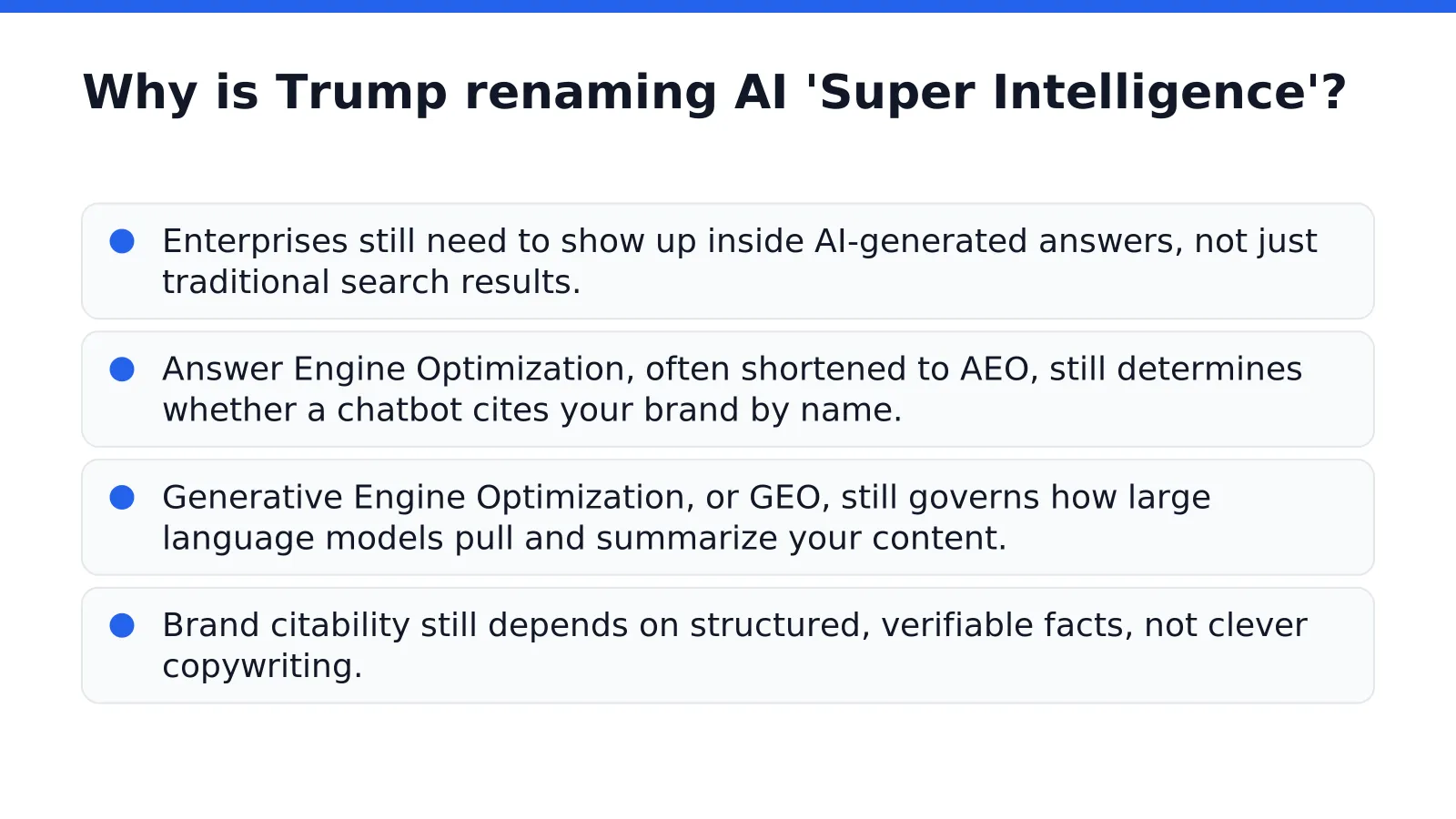
A few things stay true regardless of what the technology gets called:
- Enterprises still need to show up inside AI-generated answers, not just traditional search results.
- Answer Engine Optimization, often shortened to AEO, still determines whether a chatbot cites your brand by name.
- Generative Engine Optimization, or GEO, still governs how large language models pull and summarize your content.
- Brand citability still depends on structured, verifiable facts, not clever copywriting.
Call it AI. Call it Super Intelligence. The visibility problem for enterprise brands doesn’t rename itself away.

Does renaming AI change how it searches?
Renaming does nothing to the underlying retrieval models that decide which brands get cited. Calling the technology “Super Intelligence” instead of artificial intelligence changes the label on the box, not the mechanics inside it. We watch this distinction closely because our clients ask us almost weekly whether political or cultural shifts in AI terminology affect their AI search visibility. The honest answer: no, and treating a rebrand as a strategy update wastes time you should spend on citability instead.
The push for new terminology comes from a real anxiety in Washington and Silicon Valley. Leaders worry public backlash against AI and data centers will slow the development of what they consider a powerful and potentially dangerous technology. That worry sits alongside a parallel trend: several states have started imposing safeguards, and industry leaders themselves have warned about unchecked advancement. None of that policy noise touches how a generative engine ranks, retrieves, or cites an Enterprise Brand Visibility source.
Is “Super Intelligence” the same thing as AI?
No. Researchers already use Super Intelligence to describe AI systems smarter than any human, a specific technical threshold, not a marketing term. The proposed rename borrows a phrase with real meaning in AI research and repurposes it for political branding. That mismatch creates confusion, not clarity.
For enterprise teams, the lesson is simple:
- Terminology debates don’t change Answer Engine Optimization (AEO) mechanics or how engines evaluate Generative Engine Optimization (GEO) signals.
- Citation algorithms respond to structured, verifiable content, not political labels.
- Brand citability depends on your entity data, not the vocabulary journalists use this month.
We build visibility strategies around what actually moves citations. Labels change. Retrieval logic doesn’t.

Why does AI search visibility matter now?
Search behavior shifted faster than most enterprise marketing teams reacted. We watch enterprise brands lose ground every quarter they treat this as a side project instead of the main event.
Here’s the part that should worry any CMO managing a multi-market brand: 35% of Gen Z users now search inside large language models instead of typing into traditional search engines. That audience isn’t coming back to the old search bar. They’re asking ChatGPT and Perplexity directly, and if your brand isn’t part of the answer, you don’t exist to them.
Does this actually affect enterprise brands, or just small businesses?
It hits enterprise brands harder, not softer. Larger organizations run more product lines, more regional pages, and more entity confusion across subsidiaries. Without Answer Engine Optimization (AEO), the practice of structuring content. AI engines can extract and cite direct answers, businesses lose visibility at the exact moment customers are actively searching for solutions.
What happens if we wait another year to address this?
Waiting compounds the gap. Competitors building AI search visibility now are training the models’ retrieval patterns while slower brands stay invisible in the citations that matter.
We build practical applications of AI technology specifically to restore. Grow search visibility for Enterprise Brand Visibility clients, not generic traffic plays. That work spans two disciplines:
- Generative Engine Optimization (GEO): structuring content so generative engines surface and cite it accurately
- Brand citability: the measurable likelihood an AI engine references your brand by name as a trusted source
Ignore either one, and Enterprise Brand Visibility shows up nowhere when the next buyer asks an AI engine for a recommendation.
What is Answer Engine Optimization exactly?
Answer Engine Optimization (AEO) structures content so AI-powered answer engines like ChatGPT, Google’s AI Overviews, Perplexity, Claude, and Gemini surface it as a trusted answer. We treat AEO as the foundation of Enterprise Brand Visibility work, because an answer engine either names your brand or it names a competitor. There is no middle ground.
Traditional SEO chases rankings. AEO chases citations. That distinction matters for enterprise marketing teams managing Enterprise Brand Visibility across dozens of product lines and regional pages. A page ranked #1 on Google can still be completely absent from an AI-generated answer.
Getting cited requires structure, not luck. We build AEO around content AI systems can actually parse:
- FAQ formats that mirror how people phrase questions to a chatbot
- Concise, direct responses instead of buried answers three paragraphs deep
- Schema markup that labels entities, relationships, and facts explicitly
- Entity-rich language that names people, products, and locations clearly
Why does AEO matter right now for enterprise brands?
Search behavior already shifted, and the data backs it up. We’ve watched enterprise clients treat that number as a future problem. It’s already here.
Who is actually searching this way?
Gen Z leads the shift. Thirty-five percent of Gen Z users now search on large language models instead of traditional search engines, which tells us the next decade of enterprise customers will default to AI answers first. For any organization managing Enterprise Brand Visibility across multiple markets, that’s a demographic you can’t optimize around later.
AEO gives AI engines a reason to trust and repeat what your brand says. Skip it, and the answer engine fills that gap with someone else’s name.
How does Generative Engine Optimization differ from SEO?
Generative Engine Optimization, or GEO, builds content structures that AI engines pull into generated answers. Traditional SEO builds pages that climb search results pages and earn clicks. That distinction sounds small. It changes everything about how we build a content strategy for Enterprise Brand Visibility.
We treat Answer Engine Optimization as the discipline of earning citation inside AI-generated answers, not a ranking position. AEO asks a different question than SEO ever did: does the AI trust this brand enough to name it? Ranking tenth on a results page still gets traffic. Being absent from an AI answer gets nothing.
Is AEO just a rebrand of SEO?
No. AEO and GEO sit on top of a different set of AI search marketing concepts entirely, including how AI models retrieve and cite sources rather than how they rank pages. We’ve built client acquisition methodology for Enterprise Brand Visibility around those concepts specifically. The brands that win citations aren’t always the ones winning rankings.
Does enterprise system architecture matter for AI visibility?
It does, and this is where most enterprise teams fall short. Applying innovations in enterprise AI search. Comprehensive system architecture lets organizations serving Enterprise Brand Visibility optimize their digital marketing strategy from the structure up, not bolt AI tactics onto an old SEO playbook. We build brand citability into the foundation, not the finish.
What makes a brand citable to AI engines?
Citability comes down to structure, not just substance. AI engines reward content built in formats machines can parse: FAQ layouts, concise direct answers, schema markup, and entity-rich language that names exactly who a brand serves and what it does. We call this discipline Answer Engine Optimization. AEO: structuring content so AI systems can extract and cite it with confidence. Without that structure, even accurate, well-written content gets skipped.
Enterprise Brand Visibility work raises the stakes further. We build knowledge assets for enterprise clients that AI engines treat as verified sources, not guesses pulled from scattered web pages. That requires Generative Engine Optimization. GEO: the practice of shaping entity data and structured knowledge so generative systems retrieve and cite it accurately across platforms.
Why does structured content matter more than keyword rankings?
Rankings measure position on a results page. Citation measures whether an AI engine trusts a brand enough to quote it directly. We’ve watched brands hold page-one Google rankings while AI engines cite competitors instead, simply because their content wasn’t built in an answer-friendly format.
Does AI visibility affect more than just search traffic?
Yes, and most executives miss this. As AI-driven insights take over more of the research and buying journey, citability shapes user engagement and operational efficiency, not just impressions. A brand that AI engines trust gets recommended inside conversations, not just listed in results.
We handle this work from our base in Coral Springs, FL, serving enterprise clients wherever their AI search visibility needs take us. Brand citability isn’t a one-time fix. It’s an ongoing architecture of:
- Schema markup that defines entities clearly
- FAQ-style content answering real buyer questions
- Concise, extractable language over dense marketing copy
- Consistent entity signals across every owned asset
Get that architecture right, and AI engines stop guessing who a brand is.
What should enterprise leaders do next?
Enterprise marketing leaders face a narrow window before visibility gaps become permanent. Customers are searching for solutions right now, and brands without Answer Engine Optimization. AEO, the practice of structuring content so AI engines can extract and cite it directly, lose that moment entirely. We built our enterprise AI search approach around one belief: visibility strategies need to meet generative search where it already lives, not chase it after the fact.
Here’s the uncomfortable part. The conversation around AI isn’t cooling off; it’s escalating. Watch how tech leaders and policymakers are pushing to rename AI itself as “Super Intelligence,”. SI, a rebrand that signals this technology is accelerating its grip on how people find answers and make decisions. That shift matters for every CMO still treating generative search as a side project instead of the main channel.
How should enterprise teams prioritize AEO against traditional SEO?
Traditional SEO still earns clicks, but AEO determines whether a brand gets mentioned at all inside an AI-generated answer. Enterprise teams should treat the two as parallel tracks, not a replacement strategy. We recommend auditing current citation rates across major AI engines before reallocating budget.
What does an enterprise AI visibility roadmap actually include?
A working roadmap combines three disciplines working together:
- Generative Engine Optimization (GEO), structuring content and data so generative models retrieve and cite it accurately
- Brand citability audits, measuring how often AI engines already reference the brand versus competitors
- Practical AI search applications built to enhance visibility as generative search adoption grows
Enterprise leaders who move on this now protect ground that competitors will fight much harder to reclaim later. Book a strategy call to audit where your brand stands today.
FAQ
What is Answer Engine Optimization?
AEO structures content so AI engines extract and cite it directly as an answer. Without it, prospects never see a brand because AI assistants never surface it in the first place.
How is Generative Engine Optimization different from AEO?
GEO addresses how large language models pull, synthesize, and attribute information across a brand’s entire digital footprint, not just a single page. Combined with AEO, it builds brand citability, the measurable likelihood AI engines name a brand as a trusted source.
Who helps enterprise brands close AI visibility gaps?
InnovAit AI, based in Coral Springs, FL, works with enterprise brands nationwide to close AI visibility gaps before competitors close them first. Their AI systems exist specifically to strengthen AI search visibility for enterprise brands in competitive markets.
Conclusion
In closing, the superintelligence era isn’t coming, it’s here, and it’s rewriting the rules of enterprise visibility. Brands that treat AI citation as an afterthought to traditional search will find themselves invisible where their customers are already asking questions. The window to establish authority with AI systems is open now. The brands that move first own the next decade of discovery.