
Executive Summary of the 2026 Enterprise AI Visibility Benchmark
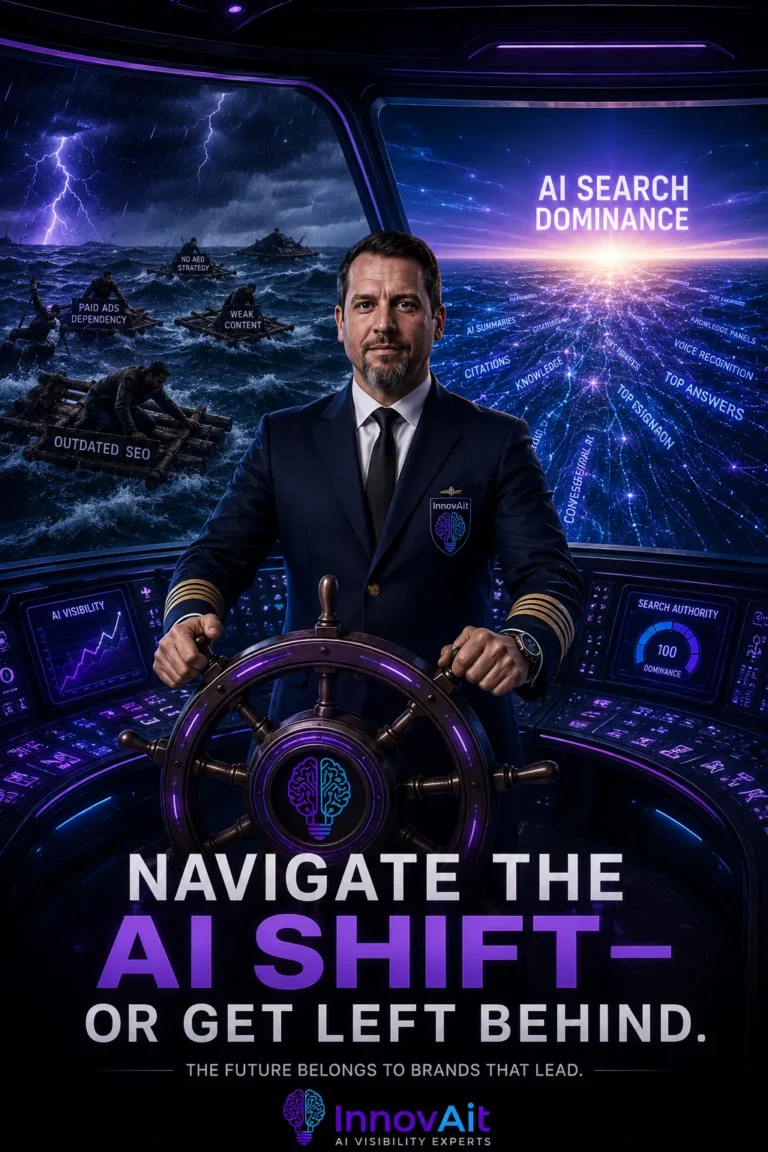
The 2026 Enterprise AI Visibility Benchmark reveals a critical structural gap confronting B2B enterprise brands: an overwhelming 80% remain invisible to AI-powered search platforms such as ChatGPT, Perplexity, Claude 3.7, and Gemini. This invisibility stems not from insufficient content volume but from the lack of structured, machine-readable content capable of being parsed and cited by retrieval-augmented generation (RAG) systems. InnovAit AI, headquartered in Coral Springs, FL, has developed this benchmark framework which emphasizes AI citation frequency across a comprehensive panel of large language model (LLM)-based engines and zero-click generative search environments. It challenges the traditional dependence on page-one Google rankings alone, demonstrating the necessity of specialized Answer Engine Optimization (AEO) and Generative Engine Optimization (GEO) strategies to elevate AI search visibility.
Analytics from Foglift’s Q3 2026 audit, surveying over 500 enterprise B2B brands, highlight stark deficiencies: many top-25 domain names recorded citations on only a single AI engine. This divergence underscores that ranking well in traditional Search Engine Results Pages (SERP) no longer guarantees a brand’s discoverability within AI-generated answers leveraging techniques such as cosine similarity in dense vector embeddings, knowledge graph nodes integration, and Knowledge Graph Schema and JSON-LD entity markup.
Why Do 80% of B2B Brands Fail in AI Search Despite High Google Rankings?
A majority of B2B brands operate under legacy SEO assumptions optimized solely for Google’s page-one algorithmic ranking—a methodology increasingly misaligned with the dynamics of AI-driven responses. The growing use of unbranded category prompt citations within generative search engines means that responses are synthesized from a knowledge base augmented by sparse BM25 dense sparse hybrid ranking approaches combined with dense vector search indexing rather than direct URL rankings.
Key contributing factors to low AI search visibility include:
- Inadequate structured data: Websites lacking schema.org JSON-LD markup and reliable knowledge graph nodes struggle to achieve authoritative semantic entity disambiguation.
- Content not optimized for retrieval-augmented generation (RAG): Without context window compression, clear, concise answers, and high information gain scores, AI systems are less likely to extract and cite the brand accurately.
- Outdated content architectures: Firms relying on JavaScript frameworks rendering blank pages to crawlers fail in both ranking and AI citation.
Critical insights from the benchmark:
- 80% of B2B enterprise brands lack sufficient AI citation presence across platforms such as OpenAI ChatGPT search, Claude 3.7 Sonnet, and DeepSeek-R1 reasoning grounding.
- Traditional SEO focus on ranking fails to account for LLM brand drift, hallucination reduction, and accurate AI attribution.
- AI search visibility is a leading indicator of buyer discovery in zero-click AI search engine contexts.
How Does Answer Engine Optimization (AEO) Differ from Traditional SEO?
The Answer Engine Optimization benchmark redefines how brands assess their content’s effectiveness—not by page rank and clicks but by authoritative citations within AI-generated answers. This distinction is paramount because AI LLMs prioritize precision and trust signals such as schema.org JSON-LD markup and entity-level validation over traditional metrics.
Answer Engine Optimization (AEO) ensures content is explicitly structured for AI systems so brands earn consistent mentions within AI answers, thereby enhancing ChatGPT brand visibility and Perplexity search citations. This discipline complements Generative Engine Optimization, which focuses on maximizing content’s inclusion in generative sources.
How Do ChatGPT and Perplexity Decide Which Enterprise Brands to Cite?
ChatGPT brand visibility and Perplexity search citations are distinct yet interconnected metrics reflecting how AI conversational platforms identify and cite enterprise brands in real-time responses.
Unlike continual crawling and indexing by Google Search—which analyzes crawlable HTML content and ranks pages—LLM-based engines leverage pre-trained knowledge bases augmented by retrieval layers using dense vector embeddings and sparse BM25 dense sparse hybrid ranking for query resolution. This implies:
- Brands must enable reliable semantic entity disambiguation and semantic grounding to achieve high Share of Model (SoM).
- The quality of schema.org JSON-LD markup and persistent entity graph connections directly influence citation likelihood.
- Context window compression and hallucination reduction techniques improve answer relevance and trustworthy brand attribution supported by an elevated information gain score.
Many B2B brands rank well on Google yet remain invisible within ChatGPT or Perplexity responses due to insufficient structured entity data and AEO implementation.
What Are the 4 Pillars of Generative Search Dominance?
1. Entity Disambiguation & Semantic Grounding
Clear, concise definition of entities within knowledge graphs enables AI to accurately recognize and cite brand-related content. This reduces hallucination, minimizes LLM brand drift, and strengthens brand trust signals.
2. Knowledge Graph Structuring & Linked Data
Interlinking data through standards such as schema.org JSON-LD creates a rich semantic web that retrieval-augmented generation (RAG) models use to construct factual, verifiable answers.
3. Synthetic Retrieval Grounding & Vector Embeddings
Employing dense vector embeddings and sparse BM25 dense sparse hybrid ranking methods enhances content retrieval by AI systems, optimizing context window compression and ensuring precise alignment with user intent in zero-click AI search engine scenarios.
4. Information Gain & Verifiable Empirical Research
Content must deliver new, valuable insights substantiated by empirical data that AI models can verify, increasing the likelihood of citation and bolstering domain authority in generative environments.
How Can Enterprise Leaders Measure and Audit Their AI Search Visibility?
InnovAit AI’s methodology integrates 75 unbranded category prompt citations across 25 verticals delivered to leading platforms including OpenAI ChatGPT search (o1/o3 models), Claude 3.7 Sonnet, DeepSeek-R1 reasoning grounding, Gemini, Google AI Overviews, and Perplexity Pro citations. Results include 375 answers and more than 3,400 cited URLs from over 1,500 distinct domains—allowing a rigorous assessment of enterprise AI search visibility and Answer Engine Optimization benchmark performance.
Consistency in benchmark validity is maintained through fixed prompts, engines, time windows, and scoring versions, ensuring comparability across cycles and protecting against data noise introduced by updates in generation models or shifting indexing frameworks.
Claim Your Complimentary AI Visibility Audit with InnovAit AI
Enterprise marketers and technology leaders seeking to bridge the AI visibility gap can leverage InnovAit AI’s expert guidance and technology-driven audits to improve their AI presence. Our comprehensive audits analyze your domain’s performance on ChatGPT brand visibility, Perplexity search citations, and overall generative search footprint, providing actionable recommendations across the 4 pillars of generative search dominance.
- Visit us online at InnovAit AI for comprehensive AI visibility audits and Answer Engine Optimization consulting.
- Call +1 954-841-7484 to speak directly with an enterprise AI search specialist.
Take control of your AI search visibility now, and ensure your brand is not left invisible in the era of generative AI.
FAQ
What is the 2026 Enterprise AI Visibility Benchmark?
A structured framework measuring brand citation frequency across generative AI engines like OpenAI ChatGPT search, Perplexity Pro citations, Claude 3.7 Sonnet, and Gemini using unbranded category prompt citations, reflecting AI search visibility more accurately than traditional rankings.
How does the benchmark measure AI search visibility?
Using a fixed set of real purchase decision prompts, the benchmark tracks AI engine citations to produce repeatable scores for AI search visibility, rather than snapshot rank data, incorporating synthetic prompt evaluation and Share of Model (SoM) metrics.
Why does AI search visibility matter for B2B brands?
Because over 60% of AI-driven searches end without clicks (zero-click AI search engine), AI searches have grown by more than 500% year-over-year, and roughly 35% of Gen Z users now search directly within large language models—making AI visibility an essential competitive advantage.
Key Takeaways
- Traditional SEO alone no longer ensures B2B brand discoverability in generative AI search results.
- Integrating Knowledge Graph Schema, JSON-LD entity markup, and semantic entity disambiguation is critical for maximizing AI citations.
- Answer Engine Optimization benchmark and Generative Engine Optimization report provide complementary insights for holistic AI search visibility strategies.
- Focusing on ChatGPT brand visibility and Perplexity search citations enables better alignment with modern buyer journeys in zero-click generative search environments.
- InnovAit AI’s 2026 Enterprise AI Visibility Benchmark sets the standard for rigorous evaluation and actionable consulting.
- Engage with InnovAit AI via InnovAit AI or phone +1 954-841-7484 to schedule your AI visibility and entity audit today.