
Custom AI integrations are a strategic capability for enterprises seeking measurable improvements in efficiency and growth. These tailored systems apply machine learning and automation to reduce manual effort, surface actionable insights from large data sets, and deliver personalised customer interactions. For organisations undergoing digital transformation, a clear understanding of integration benefits, deployment approaches and sector-specific use cases is essential. This article summarises how bespoke AI tooling can materially improve lead generation and overall business performance.
Custom AI integrations are the bespoke deployment of AI technologies within an organisation’s existing software and processes to increase functionality and operational effectiveness. They automate repetitive tasks, parse and analyse large datasets, and generate insights that support faster, data-informed decisions. Core strategic benefits include higher operational efficiency, stronger decision quality and more relevant customer experiences.
InnovAit AI delivers custom integrations designed to capture these benefits and maintain competitive positioning within target markets.

Custom integrations streamline end-to-end workflows and optimise resource allocation to reduce operational expense and error rates. Automation of routine processes lowers manual overhead, while AI-driven analytics identify bottlenecks and enable targeted process improvements that increase throughput and productivity.
Implementing AI also creates measurable growth vectors: product and service innovation, improved customer engagement and data-driven marketing that increases conversion efficiency. Analysing customer behaviour at scale enables precisely targeted campaigns that raise conversion rates and revenue per customer.
Different AI integration solutions deliver distinct benefits through specific mechanisms.
| Integration Type | Mechanism | Benefit | Impact Level |
|---|---|---|---|
| API Integrations | Seamless data exchange | Enhanced interoperability | High |
| Machine Learning | Predictive analytics | Improved decision-making | High |
| Automation Tools | Task automation | Increased efficiency | Medium |
The table highlights how different integration types contribute to operational outcomes and strategic growth.
Specific sectors derive substantial value from tailored AI tooling due to their data intensity and regulatory or operational complexity.
Targeting these industries allows firms to apply AI to clearly defined business problems and unlock new revenue and efficiency gains.
AI API integration services enable reliable data exchange across platforms, automating lead capture, enrichment and routing to accelerate pipeline velocity and improve data quality for downstream systems.
Research consistently emphasises the growing role of AI across lead research, generation, engagement, scoring and automation.
AI in B2B Lead Management & Generation: Key Tactics & Tools
The study, which focused on business-to-business (B2B), was conducted between November 2023 and January 2024, and shows that using artificial intelligence (AI) in lead management is becoming increasingly important. In particular, the areas of lead research, lead generation, lead engagement, lead scoring, and lead automation were analyzed.
Marketing Automation & AI Report 2024: tactics & tools of
AI-based lead generation, D Zumstein, 2024
InnovAit AI’s API integration services are built to optimise those lead-generation workflows and improve conversion efficiency across marketing and sales systems.
Successful AI API integration follows a structured sequence to reduce risk and ensure alignment with business objectives.
Executing these stages methodically helps organisations achieve predictable deployments and operational continuity.
AI automation refines operations and strengthens conversion pipelines by ensuring consistent follow-up, reducing manual delays and enabling personalised communications at scale.
InnovAit AI’s automation solutions focus on reducing cycle times and improving conversion metrics through targeted orchestration and analytics.
Adherence to proven practices increases the probability of delivering reliable, maintainable AI systems that align with business needs.
Implementing these practices helps organisations maximise the value of their AI investments while controlling operational risk.
Scalable AI design requires forward-looking architecture, clear objectives and flexible data integration to support growth without rework.
These strategies enable enterprises to deploy AI solutions that meet current requirements and scale as usage and data volumes increase.
Quantitative metrics are essential to validate AI investments and guide future spending decisions.
Focusing on these KPIs enables clear measurement of impact and supports business cases for continued AI investment.
AI optimisation improves lead generation efficiency by refining processes, sharpening targeting and enabling personalised outreach based on analytic signals.
InnovAit AI’s optimisation services are designed to operationalise these techniques and improve measurable lead-generation outcomes.
Effective techniques combine predictive analytics, personalised campaigns and automated engagement to increase pipeline quality and conversion velocity.
Applying these techniques in combination enables organisations to raise lead quality and improve conversion rates reliably.
Measuring AI impact requires a structured approach to KPI selection, continuous analysis and controlled experimentation.
Consistent monitoring and iterative testing ensure AI-driven optimisations deliver sustained improvements across the funnel.
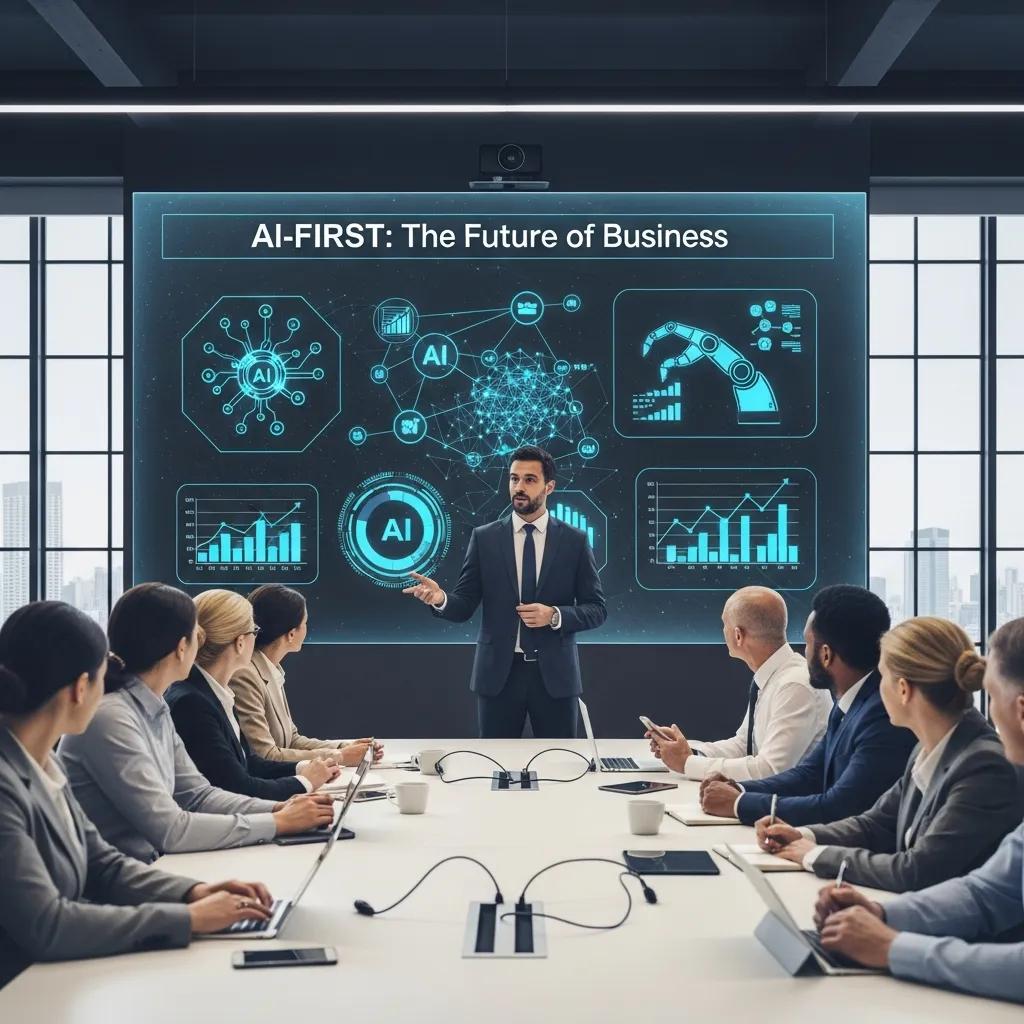
An AI-first posture enables organisations to leverage data and automation as foundational capabilities, driving efficiency, cost reduction and better strategic decisions.
The impact of AI extends beyond incremental process gains to fundamental changes in business models and organisational design.
AI’s Impact on Business Transformation & New Enterprise Models
Among disruptive technologies, Artificial Intelligence (AI), Robotic Process Automation (RPA) and Machine Learning (ML) play a very important role in Businesses Transformation and continues to show great promise for creating new sources of wealth and new business models. The reality of AI in the company is not reduced to a simple process optimization. In fact, AI introduces new organizational schemes, new ways of working, new optimization niches, new services, other ways of thinking about interactions with customers and therefore a new way of doing business.
How Enterprise must be Prepared to be “AI First”?, N Berbiche, 2021
Adopting an AI-first strategy helps organisations preserve competitiveness as digital capabilities become core to market differentiation.
A robust AI-first strategy combines scalable data infrastructure, targeted talent acquisition and a culture of continuous learning to sustain long-term value capture.
These components create the organisational foundation required to scale AI capabilities and capture measurable outcomes.
Custom integrations align AI capabilities with business objectives, improve inter-system communication and enable continuous optimisation of processes and models.
Leveraging custom AI integrations enables organisations to execute AI-first transformation with controlled risk and measurable performance improvements.
Common challenges include poor data quality, which degrades model outputs; organisational resistance that slows adoption; technical complexity when integrating with legacy systems; and the need for ongoing maintenance to preserve model performance as conditions change.
Security requires layered controls: strong encryption for data in transit and at rest, regular security audits and vulnerability assessments, strict access controls and role-based permissions, and staff training on data privacy and security procedures to reduce human risk factors.
Employee training is essential. It ensures users understand system capabilities and limitations, reduces operational errors, accelerates adoption and helps embed AI into standard operating procedures. Training should cover technical use, governance and the strategic rationale for the solutions.
Success is measured with specific KPIs such as reduced processing times, cost savings, improved lead conversion rates and higher customer-satisfaction scores. Organisations should calculate ROI by comparing financial benefits to implementation and operational costs and perform regular reviews to refine the approach.
Key trends include wider adoption of explainable AI for transparent decisioning, tighter integration of AI with IoT and blockchain for new data architectures, and continued advances in natural language processing that improve human–AI interaction and automation capabilities.
Small businesses can automate routine tasks to free capacity, deploy chatbots to improve customer service, and use targeted analytics to inform marketing and operational decisions. Tailored AI solutions enable smaller organisations to compete more effectively by improving efficiency and insight-driven decision-making.
Custom AI integrations provide a strategic advantage by improving operational efficiency, strengthening decision-making and enabling personalised customer experiences. When implemented with clear objectives and measurement, these solutions unlock growth and better lead-generation outcomes. Explore tailored AI options to elevate your organisation’s performance and realise measurable business impact.
Selecting the right tools for your stack starts with a clear enterprise AI architecture strategy.
custom ai integration, what is custom ai integration and when do you need it, custom ai integrations, custom ai integration solutions, custom tool integration solutions, custom ai integration platform, custom ai integration services
Make your custom AI integrations work harder by coupling them with our AEO and GEO services to drive inbound discovery through AI search engines.