
AI sales assistants and qualification agents are reshaping lead generation and qualification by applying advanced algorithms and conversational AI to sales workflows. These systems streamline processes, increase customer engagement, and support revenue objectives. This article defines their functionality, explains automated qualification, and summarizes the measurable benefits for sales teams. As competition and efficiency demands rise, you need a clear view of how these solutions optimize workflows, deliver efficiency gains, and integrate with existing automation platforms.
AI sales assistants are software platforms that help sales teams manage leads and automate qualification using machine learning and natural language processing. They engage prospects, capture qualification data, and assess lead quality in real time so sales reps can focus on higher-value activities like closing. By providing data-driven insights and personalised interactions, these tools improve lead prioritisation and contribute to higher conversion rates.
AI sales assistants and qualification agents perform complementary roles. Assistants engage prospects across channels—chat, email, voice—to collect and nurture information. Qualification agents evaluate that data to determine readiness for sales engagement. Together they reduce manual handoffs and ensure your sales team receives only the most promising leads, improving operational efficiency and conversion consistency.
To clarify capabilities, distinguish traditional scripted chatbots from advanced AI agents that execute complex, multi-step sales automation.
AI Agents vs. Chatbots: Multi-Step Sales Automation
Automation tools address repetitive customer interactions, lead qualification, and support tasks. Scripted chatbots handle straightforward queries but lack the contextual reasoning and adaptive decision-making required for multi-step workflows. Advanced AI agents extend those capabilities by leveraging large language models and reasoning frameworks to autonomously manage multi-stage processes such as deal coaching, opportunity analysis, and cross-system task orchestration.
Chatbots vs AI Agents: The Shift toward Multi-Step Automation in Sales Support Workflows, 2026

Conversational AI enables real-time engagement with prospects, capturing qualification data 24/7 via chatbots and virtual assistants. This reduces initial outreach time, automates information collection, and lets your sales team prioritise leads by engagement and intent. Properly implemented, conversational AI ensures representatives focus on leads with the highest likelihood to convert.
Integrating Natural Language Processing and Reinforcement Learning further extends conversational AI capabilities, notably for AI-powered voice assistants.
AI Voice Assistants: Enhancing Sales with NLP
The referenced study examines how AI-powered voice assistants, when combined with Natural Language Processing (NLP) and Reinforcement Learning (RL), can improve sales strategies, optimise customer interactions, and increase efficiency within sales teams.
Enhancing Sales Performance with AI-Powered Voice Assistants: Leveraging Natural Language Processing and Reinforcement Learning Algorithms, P Gupta, 2020
Qualification agents deliver measurable improvements in operational performance, including time savings, better lead targeting, and automated lead scoring that supports prioritised follow-up.
InnovAit AI specializes in AI Sales Assistants and Qualification Agents, focusing on delivering AI-first solutions that enhance sales qualification and lead generation for businesses.
Data-driven lead scoring and automated qualification workflows can increase lead qualification efficiency by up to 40%. That figure reflects typical industry benchmarks; actual improvements will vary by organization and implementation approach.
AI-driven engagement—combining predictive lead scoring with personalized outreach—consistently improves conversion outcomes. Automated tools maintain timely prospect contact throughout the funnel, increasing engagement quality and supporting higher close rates and revenue growth.
Integration between AI lead generation tools and sales automation platforms ensures seamless data synchronization and a single source of truth for lead information. Assess existing processes, choose compatible tools, and configure automated sync to create a cohesive sales ecosystem that frees teams to focus on closing deals rather than managing data.
Effective CRM integration automates data flows and surfaces AI insights directly within sales workflows. This enables your team to make informed decisions, tailor engagement, and optimise conversion paths—resulting in a more efficient pipeline and greater yield from each lead.
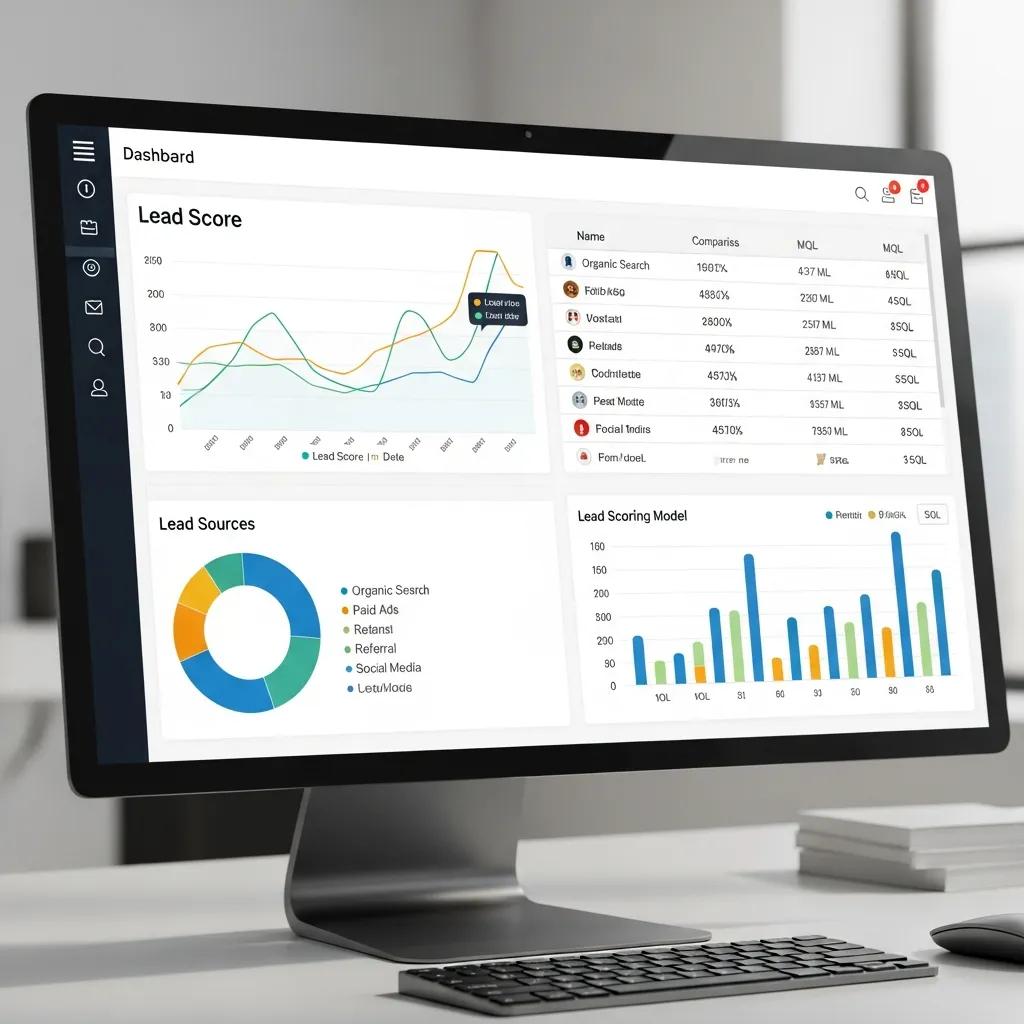
Predictive lead scoring algorithms quantify conversion likelihood from behavioural and engagement signals, allowing you to prioritise resources where they will have the highest impact. Continuous monitoring and iterative optimisation keep scoring models aligned with market shifts and customer preferences.
To maximise AI benefits, businesses should adopt targeted development and optimisation strategies that align models with commercial objectives.
InnovAit AI provides tailored development services to address specific sales requirements. Offerings include DominAit for AI search optimization, GenerAit for lead generation, and InnovAit for systems architecture—designed to help businesses leverage AI effectively to improve sales processes and support growth.
Continuous optimisation is essential: run systematic A/B tests, monitor key performance indicators, and incorporate feedback from sales teams. Those practices identify improvement areas and ensure AI solutions remain aligned with commercial goals.
Conversational AI underpins several high-impact lead generation strategies that improve qualification and engagement.
Conversational marketing tools enable real-time engagement and structured data capture. Deploy AI-driven chatbots and messaging platforms to create personalised experiences that address inquiries and surface qualification signals—improving conversion efficiency.
Automated qualification workflows increase throughput and reduce manual effort. A practical implementation follows clear steps:
Measuring effectiveness requires a defined KPI framework. Track metrics that reflect lead flow, conversion performance, and automation impact to evaluate system ROI.
Focus on KPIs that connect AI activity to business outcomes: monitor lead sources and engagement, assess how effectively prospects interact with AI tools, and measure conversion performance to validate strategy adjustments.
Implement structured data (for example, schema.org formats) to improve SERP visibility and increase inbound lead volume. Monitor related performance metrics to assess impact and iterate on schema implementations.
Dr. Emily Carter is a recognized expert in artificial intelligence applications for sales and marketing, with over 15 years of experience in AI-driven business transformation. She holds a PhD in Computer Science specializing in machine learning and has consulted for leading technology firms and sales organizations worldwide. Dr. Carter contributes regularly to industry journals and speaks at international conferences on AI innovation and sales automation strategies.
Her insights combine deep technical knowledge with practical sales expertise, helping businesses leverage AI to optimize workflows, increase revenue, and enhance customer engagement.
AI sales assistants are applicable across company sizes—from startups to large enterprises—and fit industries including e-commerce, real estate, finance, and technology. By automating lead qualification and improving customer engagement, they help you lower operational costs and increase conversion rates, making them especially valuable for organisations seeking to streamline sales efforts.
AI assistants use natural language processing and machine learning to understand and respond to enquiries in real time. They provide relevant information, gather qualification data, and operate 24/7 via chatbots or virtual agents, allowing your sales staff to focus on complex, high-value interactions.
Common challenges include data integration, user adoption, and maintaining response accuracy. You must ensure system compatibility to avoid data silos, train staff to use the tools effectively, and allocate resources for continuous monitoring and optimisation to preserve relevance and accuracy.
Yes. By personalising experiences and providing timely support based on customer data, AI assistants enhance satisfaction and help resolve issues proactively. That sustained, relevant engagement contributes to higher retention and repeat business.
AI sales assistants adhere to industry regulations such as GDPR and CCPA and implement encryption protocols for data in transit and at rest. Strong data governance policies, regular security audits, and timely updates are essential to protect customer information and maintain trust.
Feedback is essential: collect input from sales teams and customers to refine models and response logic. Continuous learning from interactions enables the AI to adapt to changing preferences and market conditions, keeping performance aligned with your business objectives.
Measure ROI by analysing KPIs such as conversion rates, lead generation efficiency, and customer engagement metrics. Compare implementation and maintenance costs against revenue improvements, and include time-savings and productivity gains to assess overall financial impact.
AI sales assistants and qualification agents improve efficiency, sharpen lead targeting, and automate qualification workflows to drive measurable sales outcomes. By leveraging these technologies, businesses can concentrate on high-value interactions that increase revenue and competitive positioning. Embracing AI solutions optimises sales workflows and supports scalable growth. Discover how our tailored AI services can elevate your sales strategy today.
Increase the volume of AI-referred leads your sales assistants handle by adding our AEO services to your growth stack.