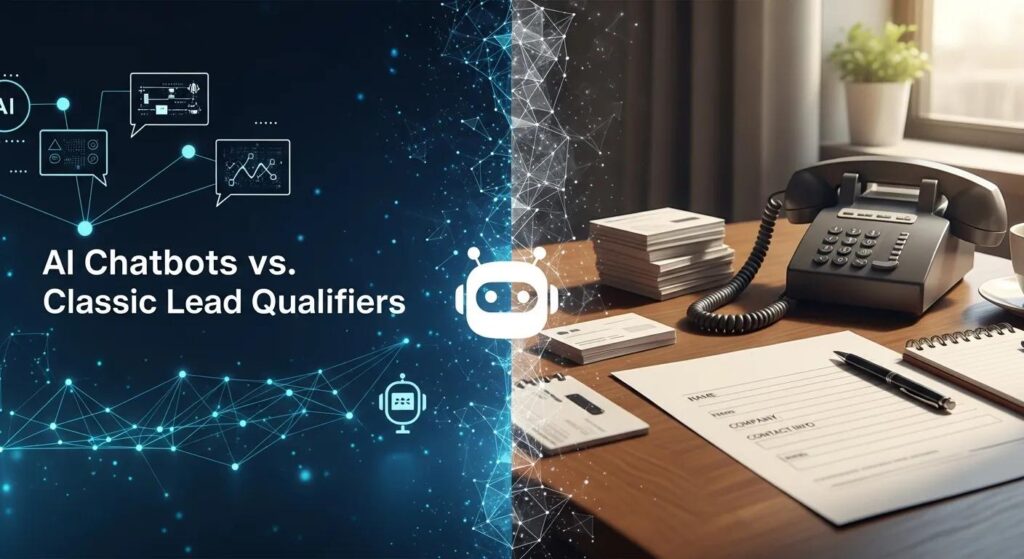
In lead generation, organizations are increasingly deploying AI chatbots for lead qualification, recognizing their potential to revolutionize traditional sales funnels. This article compares AI chatbots and traditional methods, explaining how automation not only increases efficiency and qualification accuracy but also enhances customer engagement and scalability. It outlines chatbot mechanisms, limitations of manual workflows, and the measurable business benefits of AI-driven solutions, including cost savings and improved data insights. Understanding these differences is essential for optimizing lead qualification workflows, improving sales outcomes, and making informed decisions about technology investments in a competitive marketplace.
AI chatbots and manual lead qualification differ fundamentally in their engagement model, data processing capabilities, and scalability. Traditional methods depend heavily on human-driven workflows, which can be time-consuming and prone to inconsistency. In contrast, chatbots automate user engagement by delivering real-time responses, performing continuous data analysis, and adapting conversations based on user input. This automation reduces cycle time, enables personalized interactions at scale, and improves both efficiency and customer experience by providing instant, relevant responses. Additionally, AI chatbots can handle multiple leads simultaneously, a feat impossible for human agents, thereby significantly increasing throughput and reducing lead drop-off rates.
Chatbots apply sophisticated algorithms and machine learning techniques to conduct real-time conversations, capture qualifying attributes such as budget, timeline, and needs, and calculate lead scores based on predefined criteria. Continuous model training refines intent recognition and scoring logic, enabling more accurate qualification and incremental conversion improvements over time. Automation shifts initial qualification from manual effort to intelligent systems that route high-potential leads for targeted nurturing, freeing sales teams to focus on closing deals. Furthermore, chatbots can integrate contextual data from previous interactions and external sources to enrich lead profiles, enhancing the precision of qualification and personalization.
This approach is increasingly adopted by enterprise organizations, which leverage conversational AI platforms to streamline demand generation and lead qualification workflows, reduce human error, and accelerate the sales cycle. Enterprises benefit from the scalability and consistency of AI chatbots, which can be deployed across multiple channels including websites, social media, and messaging apps, ensuring a seamless omnichannel experience for prospects.
Enterprise Conversational AI for Lead Qualification Workflows
Enterprise organizations increasingly employ conversational AI platforms to support marketing and sales operations, particularly in demand generation and lead qualification workflows. While research on conversational systems has advanced rapidly [1], [2], comparatively little work has documented how such systems are architected and evaluated in real-world enterprise deployments that directly influence revenue-generating business processes. This paper presents a comprehensive technical and operational analysis of an enterprise conversational AI platform built on the Rasa framework and deployed to support demand generation and lead generation through guided conversational workflows. The system is designed to capture user interest in products, answer product-related questions, qualify prospects, and schedule sales demonstrations.
World Deployment of an Enterprise Conversational AI Platform for Demand Generation and Lead Generation Using Guided Workflows with a Rasa-Based Chatbot, SK KOTA, 2022
Manual lead qualification is constrained by static forms, delayed responses, and lead leakage as prospects disengage due to slow or impersonal follow-up. Reliance on human judgment introduces variability in scoring and prioritization, which increases the risk of missed opportunities and inconsistent customer experiences. Additionally, manual processes often lack real-time data integration, limiting the ability to dynamically adjust qualification criteria based on evolving market conditions or customer behavior. These constraints underscore the need for more consistent, scalable, and efficient qualification mechanisms that can adapt quickly to changing business needs and customer expectations.
AI chatbots deliver measurable business benefits that extend beyond operational efficiency to include higher conversion rates, improved lead quality, and reduced acquisition costs. By automating routine qualification and engagement tasks, organizations can redeploy resources to higher-value activities such as personalized sales outreach and strategic planning. AI chatbots also standardize qualification outcomes, reducing human bias and error, and provide rich data analytics that inform continuous improvement of marketing and sales strategies. These benefits collectively contribute to a more predictable and scalable lead generation pipeline, enhancing overall business growth and competitiveness.
Chatbots increase conversion and throughput through automated follow-up and 24/7 availability, ensuring timely responses that preserve prospect interest and reduce drop-off rates. Empirical studies attribute conversion gains to the ability of chatbots to handle multiple interactions simultaneously while maintaining consistent response quality and personalized engagement. By delivering instant answers to common questions and qualifying leads in real-time, chatbots shorten the sales cycle and improve the likelihood of converting prospects into customers. Additionally, chatbots can proactively re-engage dormant leads through targeted messaging, further boosting conversion rates. Indeed, studies consistently demonstrate that AI-powered tools like chatbots significantly improve customer engagement and conversion rates through personalized, real-time interactions that adapt to user behavior and preferences. This dynamic engagement fosters trust and satisfaction, which are critical factors in driving purchase decisions and long-term customer loyalty.
AI Chatbots Boost Engagement and Conversion Rates
Companies utilizing AI tools report a substantial increase in engagement and conversion rates. Chatbots and virtual assistants, powered by AI, can engage with customers in real-time, providing personalized recommendations and support, leading to higher engagement and conversion rates.
Leveraging artificial intelligence for personalized marketing campaigns to improve conversion rates, TV Iyelolu, 2024
Automated lead scoring reduces manual workload and associated labor costs by minimizing the need for extensive human intervention in early-stage qualification. Organizations can reallocate staff to revenue-generating functions, decrease training and onboarding overhead, and operate with lower administrative expense through streamlined qualification workflows. Furthermore, automation reduces errors and inconsistencies that can lead to costly follow-up on unqualified leads. The scalability of AI systems also means that businesses can handle larger lead volumes without proportional increases in staffing, resulting in significant cost efficiencies as the organization grows.
Integrating chatbots with CRM systems ensures synchronized data and automates qualification workflows, creating a seamless flow of information between customer interactions and sales processes. The combined dataset provides a unified view of customer interactions, enabling targeted engagement informed by real-time signals such as browsing behavior, previous purchases, and communication history. This integration facilitates more accurate lead scoring, personalized messaging, and timely follow-ups, which collectively improve conversion rates and customer satisfaction.
Key features include personalized messaging that references prior interactions and workflow automation that advances qualified leads through predefined sales stages. These capabilities improve engagement relevance and operational consistency by ensuring that leads receive contextually appropriate communications at each stage of the sales funnel. Additionally, integration supports automated task assignments, alerts for sales teams, and performance tracking, enabling more efficient resource allocation and better alignment between marketing and sales efforts.
Bi-directional data flow between chatbots and CRM accelerates response times and enhances lead prioritization by providing sales teams with timely visibility into lead status and intent signals. This enables prioritized follow-ups and tailored outreach that support higher conversion rates. Real-time synchronization ensures that any updates from sales interactions are immediately reflected in chatbot behavior, allowing for adaptive conversations that reflect the latest customer context. This dynamic exchange of information reduces duplication of effort, improves data accuracy, and supports a more agile and responsive sales process.
Comparative performance metrics consistently show that AI-driven solutions outperform manual methods on key indicators such as lead-to-opportunity conversion rates, response time, and qualification accuracy. AI chatbots reduce average response times from hours or days to seconds, significantly increasing the likelihood of engaging prospects while their interest is high. These improvements make AI chatbots a more effective option for organizations focused on scaling qualified pipeline and accelerating revenue growth. Additionally, AI systems provide detailed analytics that help identify bottlenecks and optimize qualification criteria continuously.
Recent industry statistics indicate that businesses utilizing AI chatbots experience a 30% increase in lead conversion rates compared to those relying on manual methods. This efficiency gain is attributed to the capacity to engage multiple leads concurrently and provide instantaneous responses, reducing lead drop-off and improving customer satisfaction. Furthermore, AI chatbots have been shown to reduce lead qualification time by up to 50%, enabling faster progression through the sales funnel and quicker revenue realization.
Reported return on investment for AI-driven qualification is substantially higher: adopters cite an average 25% increase in ROI within the first year, driven by efficiency gains, improved conversion, and reduced operational costs. The scalability and consistency of AI solutions contribute to sustained ROI improvements over time, as organizations can handle growing lead volumes without proportional increases in expenses. Additionally, AI-driven insights enable more strategic allocation of marketing budgets, further enhancing financial performance.
Despite clear benefits, implementation challenges must be considered—most notably system integration complexities, data privacy compliance, and maintaining qualification accuracy. Organizations must ensure that AI chatbots align with existing technology stacks and business processes to avoid disruption. Additionally, continuous monitoring and model retraining are necessary to maintain high accuracy and relevance as market conditions and customer behaviors evolve. Addressing these challenges proactively is critical to realizing the full potential of AI chatbots in lead qualification.
Businesses may encounter technical challenges when integrating AI chatbots with legacy systems, including compatibility issues, data synchronization delays, and limited API support. Data security and privacy concerns are paramount, as sensitive customer information must be protected during interactions in compliance with regulations such as GDPR and CCPA. The complexity of implementation requires careful planning, including stakeholder alignment, change management, and user training, to ensure a smooth transition and adoption. Additionally, organizations must prepare for ongoing maintenance and updates to keep the chatbot effective and secure.
To address integration and adoption barriers, organizations should prioritise comprehensive discovery and analysis during the planning phase to understand technical requirements and business objectives fully. Committing to continuous optimization and support through iterative testing, user feedback, and performance monitoring helps the system evolve with business needs and maximize value. Proactive governance, including clear data policies and cross-functional collaboration, ensures alignment and accountability. Investing in user education and change management fosters acceptance and effective use of AI chatbots across teams.
Emerging trends—such as increased AI visibility, enhanced personalization at scale, and integration with advanced analytics—will further enhance the precision and effectiveness of lead qualification processes. The rise of multimodal AI, combining text, voice, and visual inputs, will enable richer customer interactions. Additionally, the incorporation of predictive analytics and real-time behavioral data will allow for more proactive and context-aware lead engagement. These advancements will empower organizations to deliver highly tailored experiences that drive higher conversion rates and customer satisfaction.
Advances in AI will improve automated lead scoring through deeper data analysis, predictive modeling, and the integration of diverse data sources such as social media activity, website behavior, and third-party data. These capabilities enable more accurate identification of high-quality leads and allow marketing teams to prioritize resources more effectively, focusing efforts on prospects with the highest likelihood to convert. Enhanced explainability features will also provide transparency into scoring decisions, building trust among sales teams and stakeholders.
Research further supports the effectiveness of machine learning in automating lead scoring by analyzing various data points to predict purchase probability, enabling dynamic adjustment of qualification criteria based on evolving customer signals and market trends.
Automating Lead Scoring with Machine Learning
Companies often gather a tremendous amount of data, such as browsing behavior, email activities and other contact data. This data can be the source of important competitive advantage by utilizing it in estimating a contact’s purchase probability using predictive analytics. The calculated purchase probability can then be used by companies to solve different business problems, such as optimizing their sales processes. The purpose of this article is to study how machine learning can be used to perform lead scoring as a special application case of making use of purchase probability.
Automating lead scoring with machine learning: An experimental study, J Mezei, 2020
Enterprises are adopting AI-first lead generation strategies that emphasize continuous optimization, real-time data integration, and customer-centric personalization. By leveraging advanced analytics and machine learning, organizations refine qualification logic, automate complex workflows, and sustain competitive performance in a dynamic market. These strategies often include the use of conversational AI across multiple channels, integration with marketing automation platforms, and deployment of predictive models to anticipate customer needs. This holistic approach enables enterprises to create seamless, engaging experiences that drive higher lead quality and conversion rates.
To learn how AI can transform your business, visit Innovait AI .
AI chatbots are applicable across business sizes, from startups to large enterprises, and across diverse industries. Sectors with high inquiry volumes—such as e-commerce, real estate, SaaS, financial services, and healthcare—derive particular value from automating qualification. Implementing chatbots improves engagement by providing instant responses, streamlines workflows by automating repetitive tasks, and supports higher conversion rates through personalized interactions. Additionally, businesses with complex sales cycles benefit from chatbots’ ability to nurture leads over time and provide consistent follow-up.
AI chatbots leverage natural language processing and machine learning to interpret intent and context, drawing on extensive knowledge bases and historical data to provide relevant and accurate responses. They handle routine and many complex inquiries effectively, including product recommendations, troubleshooting, and scheduling. For highly complex or sensitive issues, chatbots can seamlessly escalate conversations to human agents, ensuring that customers receive expert assistance when needed. This triage capability optimizes resource allocation and enhances overall customer satisfaction.
Data privacy is a critical consideration in AI chatbot deployment. Businesses must comply with regulations such as GDPR, CCPA, and other regional laws, implementing robust security measures including encryption, secure storage, and access controls to protect sensitive customer information. Transparency about data usage and obtaining explicit user consent are essential to maintain trust and meet legal obligations. Additionally, organizations should conduct regular audits and risk assessments to ensure ongoing compliance and address emerging privacy challenges.
Yes. Chatbots can be extensively configured to reflect a brand’s voice through tailored language, style, and personality traits. Customization options include specific phrases, response patterns, tone adjustments, and even controlled use of humor or empathy to align interactions with brand identity and strengthen customer recognition. This personalization helps create a consistent and engaging customer experience that reinforces brand values and fosters loyalty.
Businesses should track a comprehensive set of metrics including conversion rates, response times, customer satisfaction scores (CSAT), net promoter scores (NPS), and engagement levels such as session duration and interaction depth. Monitoring the number of leads qualified, the time required to qualify them, and chatbot resolution rates provides insight into operational efficiency. Analyzing user feedback and interaction patterns helps identify areas for optimization and ensures the chatbot continues to meet evolving customer needs.
Chatbots adapt through continuous learning and data analysis, leveraging machine learning models that analyze past interactions, feedback, and behavioral trends to refine responses and engagement strategies. Regular updates and retraining ensure chatbots remain aligned with market trends, evolving customer expectations, and new product information. This adaptive capability enables chatbots to provide increasingly relevant and effective interactions, maintaining high levels of customer satisfaction and engagement.
AI chatbots transform lead qualification by automating tasks to increase efficiency, accuracy, and customer engagement. When implemented with advanced algorithms and integrated with CRM systems, they support higher conversion rates, measurable cost reductions, and enhanced data-driven decision-making. Evaluating AI-driven solutions is essential for organizations seeking to optimize lead generation, scale their sales pipeline, and maintain competitive advantage. Discover how our AI chatbot solutions can transform your business today by delivering personalized, scalable, and intelligent lead qualification experiences.