
GEO vs SEO: Understanding the Evolution of Search for AI-Driven Local Optimization
The landscape of search engine optimization (SEO) has undergone significant transformations, particularly with the advent of geo-targeting (GEO). As businesses strive to enhance their online visibility, understanding the differences between GEO and traditional SEO becomes crucial. This article delves into the evolution of search strategies, highlighting how AI-driven local optimization is reshaping the way businesses connect with their audiences. Readers will learn about the key distinctions between GEO targeting and traditional SEO, the historical development of these strategies, and the implications for businesses looking to thrive in a competitive digital environment. By addressing the challenges posed by conventional SEO methods, we will explore how generative AI is revolutionizing search engine optimization and enhancing lead generation strategies.
Key Differences Between GEO Targeting and Traditional SEO
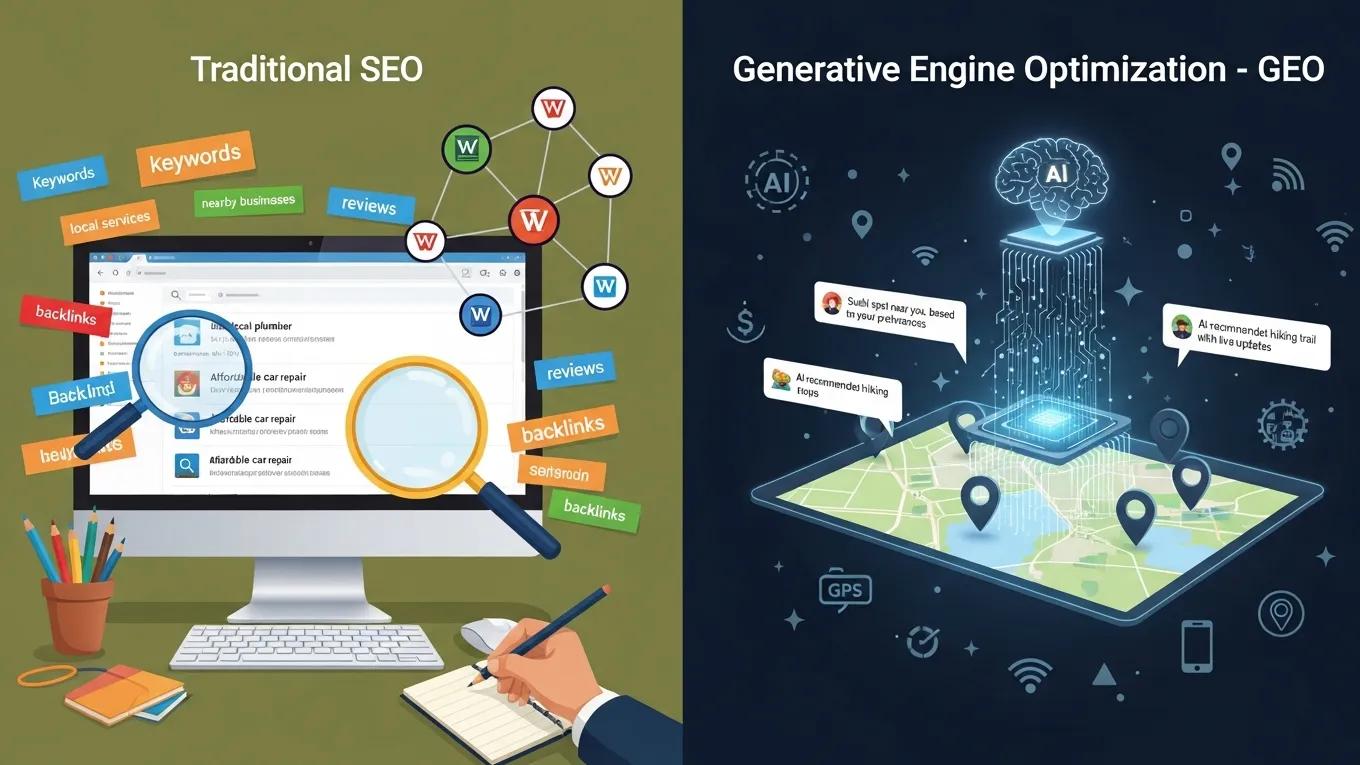
GEO targeting and traditional SEO serve distinct purposes in the digital marketing landscape. GEO targeting focuses on optimizing content and advertisements based on the user’s geographical location, ensuring that local businesses can effectively reach their target audience. In contrast, traditional SEO emphasizes broader keyword strategies and content optimization without a specific focus on location. This fundamental difference highlights the importance of user intent in shaping search results.
- Focus on User Intent: GEO targeting prioritizes local user intent, delivering relevant results based on the user’s location, while traditional SEO often relies on generic keywords that may not align with local searches.
- Content Delivery Methods: GEO strategies utilize localized content and advertisements, enhancing engagement with users in specific regions. Traditional SEO may lack this localized approach, leading to less effective outreach.
- Effectiveness in Local Search: Businesses employing GEO targeting can achieve higher visibility in local search results, driving foot traffic and online engagement. Traditional SEO may struggle to compete in local markets without incorporating geo-specific strategies.
Understanding these differences is essential for businesses aiming to optimize their online presence effectively.
Historical Development
The evolution of search strategies has been significantly influenced by changes in consumer behavior and technological advancements. Initially, traditional SEO dominated the landscape, focusing on keyword density and backlinks. However, as users began to seek more relevant and localized information, the need for GEO targeting emerged.
This shift towards more advanced search capabilities aligns with Google’s strategic pivot towards an AI-first approach, recognizing the transformative power of artificial intelligence in shaping future interactions.
Google’s AI-First Strategy & Search Evolution
In 2017 at the annual Google I/O conference, Sundar Pichai, Google’s CEO, stood up on stage and announced that the opportunities afforded by AI were such that Google was moving from a mobile-first to an AI-first strategy. That statement really brought the message home to many about the importance of AI and the need to formulate an AI strategy. Google, the technology behemoth, was turning into a full-blown AI company. They had alluded to it in the past; everyone knew that Google was heavily invested in AI and using it extensively, but this was different. It left no space for doubt. AI-first.
Defining an AI strategy, R Ashri, 2019
The shift in consumer information access has been profound, with mobile devices becoming the primary means of searching for local services. This transition has prompted businesses to adopt GEO strategies to remain competitive. The impact of AI technologies has further accelerated this evolution, providing tools that enhance the effectiveness of GEO targeting. Early adopters of these strategies have gained a competitive advantage, positioning themselves as leaders in their respective markets.
Implications for Businesses
Adopting GEO strategies presents numerous benefits for businesses looking to enhance their online visibility and engagement. By focusing on local optimization, companies can achieve:
- Enhanced Visibility: GEO targeting ensures that businesses appear in local search results, increasing their chances of being discovered by potential customers.
- Increased Engagement: Localized content resonates more with users, leading to higher engagement rates and improved customer relationships.
- Automation and Efficiency: AI-driven tools streamline the process of creating and managing geo-targeted campaigns, allowing businesses to focus on strategic growth.
InnovAit AI, as a specialized AI solutions provider, offers services tailored for businesses seeking growth and efficiency through AI-first strategies. Their expertise in lead generation and information hub services can help companies effectively implement GEO targeting to maximize their online presence.
GEO vs. SEO: Evolution of AI-Driven Search Optimization
GEO targeting and traditional SEO differ fundamentally in their methodologies and effectiveness. GEO targeting is designed to cater specifically to local audiences, utilizing location-based data to deliver relevant content. In contrast, traditional SEO often employs a broader approach, focusing on general keywords that may not resonate with local users.
- Methodologies of SEO vs GEO: Traditional SEO relies on keyword optimization and backlink strategies, while GEO targeting emphasizes local relevance and user intent.
- Effectiveness in Different Contexts: GEO targeting proves more effective in local searches, driving traffic to physical locations, whereas traditional SEO may excel in broader markets.
- Use Cases for Businesses: Businesses targeting local customers benefit significantly from GEO strategies, while those with a national or global focus may find traditional SEO more applicable.
Understanding these core differences allows businesses to tailor their strategies effectively.
How Does Geo-Targeting Enhance Local Search Optimization?

Geo-targeting enhances local search optimization by ensuring that businesses can connect with users in their immediate vicinity. This approach leverages location data to deliver personalized content and advertisements, making it easier for potential customers to find relevant services.
- Focus on Location: By prioritizing local search results, businesses can attract customers who are actively seeking services in their area.
- AI Integration: The integration of AI technologies allows for more precise targeting and personalization, improving the overall effectiveness of local search strategies.
- Examples of Effective Strategies: Successful businesses often employ geo-fencing, localized content marketing, and targeted advertising to enhance their visibility in local searches.
These strategies demonstrate the power of geo-targeting in optimizing local search results.
What Are the Limitations of Conventional SEO in the Era of AI?
While traditional SEO has been effective in the past, it faces limitations in the current landscape dominated by AI and user-centric search behaviors. The reliance on keyword-centric strategies can hinder a business’s ability to connect with local audiences.
- Keyword-Centric Focus: Traditional SEO often emphasizes keyword density over user intent, leading to less relevant search results.
- Performance in AI Contexts: As search engines evolve to prioritize user experience, conventional SEO methods may struggle to keep pace with AI-driven algorithms.
- Need for Structured Content: The lack of structured content can impede a business’s ability to rank effectively in search results, particularly in local markets.
Recognizing these limitations is crucial for businesses aiming to adapt to the changing landscape of search optimization.
How Is Generative AI Transforming Search Engine Optimization?

Generative AI is revolutionizing search engine optimization by automating content creation and enhancing user engagement. This technology allows businesses to produce high-quality, relevant content at scale, improving their chances of ranking well in search results.
The rapid advancements in generative AI technologies, such as ChatGPT and DALL-E, have fundamentally reshaped how digital content is created and automated, offering unprecedented scalability and personalization in SEO efforts.
Generative AI for Digital Content & SEO Automation
Fast-developing Generative AI technology, such as ChatGPT and DALL-E, has quietly turned digital content creation, curation, and automation upside down. These breakthrough solutions “automate” the very process of creating content, delivering creativity at scale and massively scaling the production of personalized content. This paper examines the impact of Generative AI in revolutionizing digital workflows (from content generation to curation) spanning across various domains, e.g., marketing, entertainment and education. Applications such as ChatGPT facilitate creation of text content, whereas other tools such as DALL-E boost the creation of visual content via image generation from text descriptions. Through case studies, the paper discusses human oversight vs AI efficiency, and the challenge of maintaining control over quality while also using fast, scalable AI. It also examines the role of AI in content personalization, offering a behind-the-scenes look at how AI-driven soluti
Generative AI in digital content creation, curation and automation, A Tiwari, 2022
- Evolution of Keyword Strategies: Generative AI enables businesses to develop more sophisticated keyword strategies that align with user intent and search behaviors.
- Content Creation Automation: Automated content generation streamlines the process of producing localized content, ensuring that businesses can maintain a consistent online presence.
- User Engagement Enhancement: By delivering personalized content, generative AI fosters greater user engagement, leading to improved conversion rates.
The integration of generative AI into SEO practices represents a significant advancement in the field.
What Role Does Generative Engine Optimization Play in Modern SEO?
Generative engine optimization (GEO) plays a critical role in modern SEO by focusing on the creation of content that resonates with local audiences. This approach emphasizes the importance of relevance and context in search results.
- Content Relevance: GEO ensures that content is tailored to the needs and preferences of local users, enhancing its effectiveness.
- Semantic Optimization: By leveraging semantic search principles, businesses can improve their visibility in search results and connect with users more effectively.
- Local Optimization Techniques: GEO employs various techniques, suchs as localized keywords and content strategies, to enhance search performance.
Understanding the role of GEO in modern SEO is essential for businesses looking to optimize their online presence.
How Do AI-First Strategies Improve Search Visibility and Ranking Factors?
AI-first strategies significantly enhance search visibility and ranking factors by leveraging advanced algorithms and data analytics. These strategies allow businesses to optimize their content and improve their chances of ranking well in search results.
- Content Automation: AI-driven tools streamline the content creation process, ensuring that businesses can produce high-quality content efficiently.
- User Personalization: AI technologies enable businesses to deliver personalized content to users, improving engagement and conversion rates.
- Real-Time Performance Monitoring: AI allows for real-time analysis of search performance, enabling businesses to make data-driven decisions to enhance their strategies.
The implementation of AI-first strategies represents a transformative approach to search optimization.
In What Ways Does Geo-Targeting Integrate with AI-Powered Lead Generation?
Geo-targeting integrates seamlessly with AI-powered lead generation by providing businesses with the tools to connect with potential customers in their local area. This integration enhances the effectiveness of lead generation strategies.
- Localized Content Creation: AI technologies facilitate the development of localized content that resonates with target audiences, improving engagement.
- Geo-Fencing Strategies: Businesses can employ geo-fencing to deliver targeted advertisements to users within specific geographic boundaries, increasing the likelihood of conversion.
- Local Listings Optimization: Optimizing local listings ensures that businesses appear in relevant search results, driving traffic to their websites and physical locations.
This integration highlights the importance of combining geo-targeting with AI technologies for effective lead generation.
How Does AI Leverage Geo-Targeted Data to Enhance Lead Quality?
AI leverages geo-targeted data to enhance lead quality by analyzing user behavior and preferences. This data-driven approach allows businesses to refine their marketing strategies and improve their chances of converting leads into customers.
- Localized Content Development: By understanding the needs of local audiences, businesses can create content that addresses specific pain points and interests.
- Geo-Fencing for Targeted Ads: AI technologies enable businesses to deliver targeted advertisements to users based on their geographic location, increasing the relevance of their marketing efforts.
- Local Listings Accuracy: Ensuring that local listings are accurate and up-to-date enhances the chances of attracting high-quality leads.
The use of geo-targeted data represents a powerful tool for improving lead quality.
What Are the Measurable Outcomes of Combining Geo-Targeting with AI SEO?
Combining geo-targeting with AI SEO yields measurable outcomes that can significantly impact a business’s online performance. These outcomes provide valuable insights into the effectiveness of marketing strategies.
- Conversion Rates: Businesses that implement geo-targeting alongside AI SEO often experience higher conversion rates due to improved relevance and personalization.
- Lead Quality Assessment: The integration of AI allows for more accurate assessments of lead quality, enabling businesses to focus their efforts on high-potential prospects.
- Engagement Levels: Enhanced engagement levels are a direct result of delivering personalized content to local audiences, leading to increased customer loyalty.
These measurable outcomes underscore the importance of adopting a comprehensive approach to search optimization.
What Are the Latest Trends in Search Engine Evolution Influenced by AI and Geo-Targeting?
The evolution of search engines is increasingly influenced by AI and geo-targeting, leading to several notable trends that businesses should be aware of.
- Rise of AI-Driven Personalization: Search engines are prioritizing personalized results based on user behavior and preferences, making it essential for businesses to adopt AI technologies.
- Importance of Semantic Search: Semantic search is becoming more prevalent, emphasizing the need for businesses to optimize their content for context and meaning.
- Shift from Keyword-Based SEO: As search engines evolve, there is a noticeable shift away from traditional keyword-based SEO towards more holistic approaches that consider user intent and context.
Staying informed about these trends is crucial for businesses aiming to remain competitive in the digital landscape.
How Is Semantic Search Redefining User Intent and Entity Optimization?
Semantic search is redefining user intent and entity optimization by focusing on the meaning behind search queries rather than just keywords. This shift has significant implications for how businesses approach SEO.
- Context and Meaning in Queries: Semantic search prioritizes understanding the context of user queries, allowing for more relevant search results.
- Implications for Search Strategies: Businesses must adapt their SEO strategies to align with semantic search principles, focusing on delivering valuable content that addresses user needs.
- Personalization of Search Results: The emphasis on semantic search enhances the personalization of search results, improving user satisfaction and engagement.
Understanding the impact of semantic search is essential for businesses looking to optimize their online presence effectively.
What Are the Implications of AI-Driven Search Personalization for Businesses?
AI-driven search personalization has profound implications for businesses, reshaping how they connect with their audiences. This approach enhances the user experience and drives engagement.
- Personalization Strategies: Businesses must develop strategies that leverage AI to deliver personalized content and recommendations to users.
- Customer Engagement: Enhanced personalization leads to improved customer engagement, fostering loyalty and repeat business.
- Marketing Effectiveness: AI-driven personalization increases the effectiveness of marketing efforts, allowing businesses to target their messaging more accurately.
Embracing AI-driven search personalization is crucial for businesses seeking to thrive in a competitive landscape.
How Can Enterprises Implement AI-First Search Strategies to Outperform Competitors?
Enterprises can implement AI-first search strategies by focusing on several key areas that enhance their online presence and competitiveness.
- Content Relevance Optimization: Ensuring that content is relevant to user needs and preferences is essential for improving search visibility.
- Structured Data Usage: Utilizing structured data helps search engines understand the context of content, improving indexing and visibility.
- User Engagement Strategies: Developing strategies that prioritize user engagement can lead to higher conversion rates and customer loyalty.
By adopting these strategies, enterprises can position themselves for success in the evolving digital landscape.
What Are the Stepwise Processes for Integrating Generative AI in SEO?
Integrating generative AI into SEO involves several stepwise processes that can enhance a business’s online presence.
- Content Relevance: Begin by ensuring that content is relevant to user needs and preferences, leveraging AI to analyze data.
- User Engagement: Focus on developing strategies that enhance user engagement through personalized content and recommendations.
- Automation of SEO Processes: Implement AI-driven tools to automate various SEO processes, improving efficiency and effectiveness.
These processes provide a roadmap for businesses looking to integrate generative AI into their SEO strategies.
How Do Case Studies Demonstrate Success in AI-Enhanced SEO and Geo-Targeting?
Case studies provide valuable insights into the success of AI-enhanced SEO and geo-targeting strategies. These real-world examples illustrate the effectiveness of these approaches.
- Real-World Examples: Businesses that have successfully implemented AI and geo-targeting strategies often report significant improvements in search visibility and engagement.
- Measurable Outcomes: Case studies highlight measurable outcomes, such as increased conversion rates and improved lead quality, resulting from these strategies.
- Best Practices: Analyzing successful case studies can help businesses identify best practices for implementing AI-enhanced SEO and geo-targeting.
These insights underscore the importance of adopting innovative strategies to achieve success in the digital landscape.
What Metrics and Tools Are Essential for Monitoring AI and Geo-Targeted SEO Performance?
Monitoring the performance of AI and geo-targeted SEO strategies requires specific metrics and tools that provide valuable insights.
- Key Performance Indicators: Businesses should track key performance indicators (KPIs) such as organic traffic, conversion rates, and engagement levels to assess the effectiveness of their strategies.
- Recommended Software: Utilizing software tools that specialize in SEO analytics can help businesses monitor their performance and make data-driven decisions.
- Best Practices for Analysis: Implementing best practices for data analysis ensures that businesses can effectively interpret their performance metrics and adjust their strategies accordingly.
These metrics and tools are essential for optimizing AI and geo-targeted SEO performance.
Which KPIs Best Reflect Growth from AI-Driven Local Search Optimization?
Identifying the right key performance indicators (KPIs) is crucial for measuring growth from AI-driven local search optimization. These KPIs provide insights into the effectiveness of marketing strategies.
- Organic Traffic: Tracking organic traffic levels helps businesses understand how well their SEO strategies are performing.
- Conversion Rates: Monitoring conversion rates allows businesses to assess the effectiveness of their lead generation efforts.
- Engagement Metrics: Analyzing engagement metrics, such as time on site and bounce rates, provides valuable insights into user behavior and content effectiveness.
These KPIs are essential for evaluating the success of AI-driven local search optimization efforts.
How Do Structured Data and Schema Markup Enhance Search Visibility?
Structured data and schema markup play a critical role in enhancing search visibility by providing search engines with clear information about a website’s content.
This emphasis on structured data markup is a well-established SEO technique, rooted in semantic technology, that helps search engines better understand and present web content.
Structured Data Markup for Traditional SEO
Structured Data Markup is being advocated as a search engine optimisation (SEO) technique enabled by semantic technology grafted on traditional Web development practices [1]. The origins of this approach may be traced back to data gleaning from XML documents [2] and to microformat profiles [3]. More recently, the lessons learned from microformats have led to the centralisation of prominent description vocabularies under the Schema.org “umbrella terminology” [4] founded and maintained by the big search engine providers (e.g., Google, Yahoo, Microsoft). From a conceptual perspective, Schema.org can be considered an ontology – i.e., it provides a consensus on terms (categories and properties) that should be used to describe often searched types of resources: organisations, persons, events, actions etc. The Schema.org terminology is complemented by syntaxes that can extend HTML content
Streamlining structured data markup and agile modelling methods, AM Ghiran, 2017
- Clear Organization of Information: Structured data helps organize information in a way that search engines can easily understand, improving indexing.
- Improved Indexing: By utilizing schema markup, businesses can enhance their chances of appearing in rich snippets and other enhanced search results.
- Eligibility for Rich Results: Implementing structured data increases the likelihood of being featured in rich results, which can significantly boost visibility.
Understanding the role of structured data and schema markup is essential for businesses looking to enhance their search visibility.