
The accelerating adoption of artificial intelligence (AI) requires structured AI systems training and disciplined client enablement. These initiatives accelerate integration, reduce time-to-value and enable organisations to extract measurable business benefit from AI investments. This article presents enterprise-grade strategies for AI training and client enablement, explains their role in accelerating adoption, and summarises practical approaches for workshops, ROI measurement and client onboarding that support predictable outcomes.
Comprehensive Enterprise AI Systems Training & Client Enablement Strategies for Business Growth
Effective AI systems training and client enablement increase organisational AI visibility and operational readiness. Staff gain the skills required to apply AI tools, which enables process optimisation, faster, data-informed decisions and incremental innovation. Applied correctly, AI also supports targeted lead generation and customer engagement workflows to expand pipeline. Intelligent automation then reduces manual effort, allowing teams to concentrate on strategic priorities that drive measurable growth.
Research demonstrates that embedding AI into core systems such as ERP materially changes operational workflows, producing measurable efficiency gains and improved strategic decision-making.
AI-Augmented ERP: Transforming Enterprise Operations & Integration
The strategic integration of artificial intelligence into Enterprise Resource Planning frameworks shifts legacy, rules-based architectures toward adaptive environments that deliver real-time insight, predictive analytics and autonomous decision support. Combining machine learning, natural language processing and predictive analytics with ERP enables continuous optimisation of operations, more accurate financial controls and improved supply-chain performance. AI-augmented ERP deployments therefore deliver measurable improvements in operational throughput, financial management precision and supply-chain optimisation.
AI-Enhanced ERP Systems: Transforming Enterprise Operations through Intelligent Integration, 2025
Enterprise AI Training & Client Enablement for Scalable Growth
Enterprise AI training programs are formal, role-specific initiatives that build internal capability to deploy and maintain AI solutions. They reduce adoption risk by creating consistent standards of practice, accelerate time-to-value and embed operational know-how. Typical, measurable outcomes include higher productivity, improved problem resolution rates and stronger employee engagement with digital transformation objectives.
InnovAit AI specialises in enterprise AI systems training and client enablement, delivering development, optimisation and lead-generation services tailored to organisational objectives and operational constraints.
How Do AI Training Workshops Enhance Enterprise AI Integration?

AI training workshops provide practical, hands-on exposure to AI tools and patterns relevant to specific roles. Participants acquire actionable techniques and deployment templates that reduce implementation friction. Organisations routinely convert workshop outputs into pilot projects and operational processes that accelerate adoption and generate demonstrable business value.
What Metrics Demonstrate ROI from AI Training in Enterprises?
Quantifying ROI from AI training requires tracking business outcomes linked to training interventions. Core metrics to monitor include revenue impact, cost reductions and improvements in customer engagement that can be directly attributed to trained teams and deployed models.
- Increased Revenue : AI initiatives often lead to higher sales and improved customer retention.
- Reduced Operational Costs : Streamlined processes and automation can significantly lower expenses.
- Improved Customer Engagement Metrics : Enhanced interactions with customers can lead to better satisfaction and loyalty.
These metrics illustrate the type and scale of financial benefits achievable from targeted AI training and enablement, supporting investment decisions with quantifiable evidence.
Which AI Client Enablement Strategies Drive Effective AI-First Business Transformations?
AI-first transformations require rigorous client enablement: a disciplined discovery phase, needs analysis and a customised adoption roadmap. Structured training and role-based education ensure that employees can operationalise AI capabilities. Sustained investment in capability building creates a feedback loop of continuous improvement that preserves competitive advantage.
How Does Client Enablement Facilitate Seamless AI System Adoption?
Client enablement aligns AI solutions with existing workflows to minimise disruption and improve user acceptance. It pairs continuous monitoring and optimisation with governance frameworks to ensure systems stay aligned with business objectives and regulatory requirements. This integrated approach reduces operational risk and improves long-term adoption rates.
What Are Best Practices for AI Client Onboarding and Enablement?
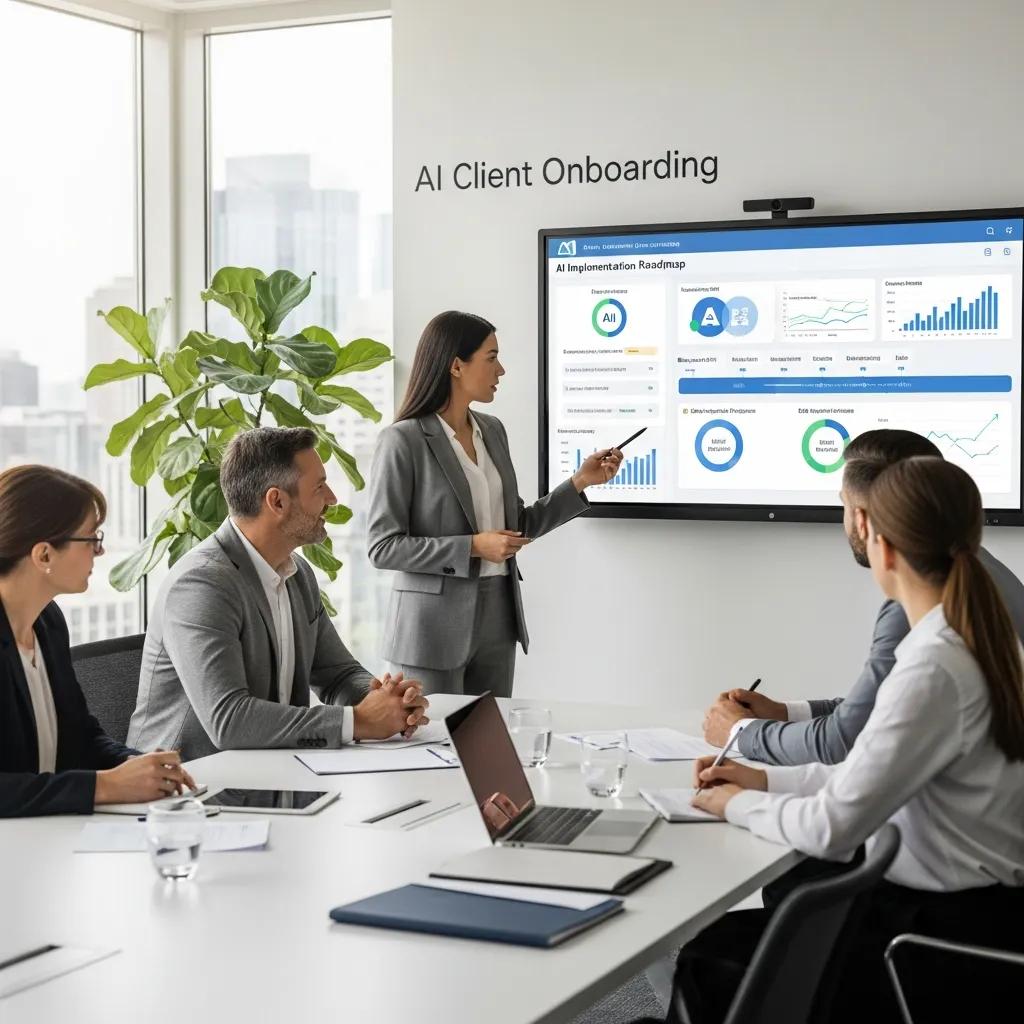
Effective AI client onboarding and enablement rely on structured support, alignment to measurable business goals and the use of practical case studies to validate approaches.
- Structured Support and Training : Providing comprehensive training resources ensures that clients can effectively utilize AI systems.
- Alignment with Business Objectives : Tailoring onboarding processes to align with specific business goals enhances the relevance of AI solutions.
- Real-World Examples of Successful Onboarding : Sharing case studies and success stories can inspire confidence and demonstrate the value of AI systems.
Specialist research quantifies AI’s capacity to streamline complex client onboarding workflows, particularly within regulated financial environments.
AI-Enhanced Client Onboarding: Streamlining Corporate Integrations & Efficiency
Implementing AI in financial systems alters architectural complexity and introduces unique risk vectors that demand disciplined integration approaches. Drawing on leadership experience in client integrations for cloud-native, high-frequency trading platforms, the referenced analysis evaluates practical limits and opportunities for AI-enhanced integrations in high-sensitivity environments. The study recommends strategies to reduce operational risk, strengthen financial infrastructure reliability and preserve architectural manageability while delivering operational efficiencies such as 30% faster onboarding and reported efficiency improvements of up to 200%.
Transformation of corporate client onboarding procedures through AI-enhanced intelligent recognition and integration systems, 2026
How Does AI Systems Optimization Maximize Enterprise Efficiency and Lead Generation?
Optimising AI systems increases operational throughput and sharpens lead generation. Agent-based workflows and intelligent automation reduce manual handoffs, while predictive analytics prioritise prospects and improve targeting precision, contributing directly to pipeline velocity and conversion quality.
What Techniques Improve AI System Performance and Scalability?
Improving AI performance and scalability requires a combination of predictive analytics, automated lead prioritisation and an operational discipline for continuous model refinement. These techniques together enable reliable forecasting, higher conversion rates and sustainable model performance at scale.
- Predictive Analytics for Forecasting : Utilizing data-driven insights to anticipate market trends and customer behavior.
- Automated Lead Scoring : Implementing algorithms to prioritize leads based on their likelihood to convert.
- Continuous Optimization of AI Models : Regularly updating and refining AI models to enhance accuracy and efficiency.
How Is Lead Generation Enhanced Through AI-Driven Optimization?
AI-driven optimisation automates repetitive tasks and personalises outreach, improving engagement rates and lead quality. Continuous learning cycles ensure models remain aligned with market dynamics and maintain conversion performance over time.
What Are the Key Components of Business AI Adoption Services for Sustainable Growth?
Sustainable AI adoption combines role-based training, seamless workflow integration and disciplined data quality management to ensure models deliver reliable, repeatable outcomes.
- Training and Education for Staff : Ensuring that employees are well-versed in AI technologies is essential for effective implementation.
- Integration with Existing Workflows : Seamless integration minimizes disruptions and enhances user experience.
- Data Quality Management : Maintaining high-quality data is critical for the success of AI initiatives.
How Do AI Development Services Support Enterprise Enablement?
AI development services deliver customised solutions that address specific operational needs, coupled with employee training and a robust data infrastructure. This combination ensures deployed models are maintainable, auditable and aligned with ongoing organisational learning.
Which AI-First Strategies Align with Business Objectives?
AI-first strategies must be anchored in a solid data infrastructure, supported by specialised talent and sustained through continuous training to produce measurable business outcomes.
- Data Infrastructure Establishment : Building a solid data foundation is essential for effective AI implementation.
- Talent Acquisition for AI Roles : Hiring skilled professionals who understand AI technologies can drive successful adoption.
- Ongoing Training and Development : Continuous education ensures that employees remain up-to-date with the latest advancements in AI.
How Can Enterprises Measure Success in AI Systems Training and Client Enablement?
Enterprises measure success by linking training and enablement to conversion rates, lead quality assessments and operational efficiency improvements that are attributable to AI initiatives.
- Conversion Rates of Leads : Tracking the percentage of leads that convert into customers.
- Lead Quality Assessments : Evaluating the quality of leads generated through AI initiatives.
- Operational Efficiency Metrics : Measuring improvements in efficiency resulting from AI integration.
What KPIs Track AI Training Effectiveness and Client Enablement Outcomes?
Relevant KPIs include AI search visibility, customer satisfaction measures and technical indicators such as model accuracy and decision latency that together demonstrate both business impact and system performance.
- AI Search Visibility Metrics : Assessing the visibility of AI-driven content in search engines.
- Customer Satisfaction Metrics : Measuring customer feedback and satisfaction levels post-AI implementation.
- Model Accuracy and Decision Latency : Evaluating the accuracy of AI models and the speed of decision-making processes.
How Do Case Studies Illustrate Tangible Business Growth from AI Initiatives?
Case studies quantify outcomes such as conversion uplift and reductions in lead qualification time, providing evidence of ROI and informing prioritisation of future AI investments.
Frequently Asked Questions
What are the key factors for successful AI system integration in businesses?
Successful integration depends on clearly defined business objectives, strong data governance and comprehensive staff training. Alignment between AI deployments and strategic goals, together with high data quality, underpins reliable model performance and sustainable adoption.
How can businesses overcome resistance to AI adoption among employees?
Mitigating resistance requires transparent communication, inclusive change management and practical training that demonstrates how AI augments roles. Showcasing pilot successes and short-term wins helps build trust and accelerate acceptance.
What types of ongoing support should organizations provide after AI training?
Post-training support should include on-demand resources, mentorship, a dedicated support channel and scheduled follow-ups. Advanced workshops and refresher modules sustain capability and adapt skills to evolving requirements.
How can businesses ensure compliance with regulations when implementing AI systems?
Compliance requires active monitoring of applicable laws, comprehensive risk assessments and governance structures that include legal and compliance stakeholders. Regular audits and policy updates ensure controls remain aligned with regulatory change.
What are the potential risks associated with AI systems, and how can they be mitigated?
Key risks include data privacy exposures, algorithmic bias and operational disruption. Mitigation requires robust data governance, periodic algorithmic audits for fairness and transparency, and training in responsible AI practices.
How can businesses leverage AI for competitive advantage in their industry?
Organisations achieve competitive advantage by using analytics to inform product and service decisions, automating routine processes to reduce cost, and implementing personalised engagement strategies that improve customer lifetime value. Continuous innovation and operational discipline secure long-term differentiation.
About the Author and InnovAit AI
This article is authored by a team of AI and enterprise technology experts at InnovAit AI, a specialist provider of AI systems training and client enablement services. With extensive experience in AI integration, development, and optimisation, InnovAit AI is committed to helping organisations achieve measurable business outcomes through tailored AI solutions. The team combines deep technical knowledge with practical industry insights to deliver effective training programs and strategic enablement frameworks.
InnovAit AI maintains a strong focus on ethical AI practices, compliance, and continuous learning to ensure clients remain at the forefront of AI innovation. For more information about InnovAit AI’s services and expertise, visit their official website or contact their client engagement team.
Conclusion
Structured AI systems training and client enablement enable organisations to capture measurable value from AI—improved productivity, better decision-making and accelerated time-to-value. Investing in tailored training, governance and optimisation delivers durable business impact. Discover how our tailored AI training solutions can transform your organization today.