Marketing teams must evaluate legacy manual techniques against AI-driven strategies. This analysis compares mechanisms, benefits, and measurable business impact. You will learn how AI methods increase efficiency and effectiveness relative to conventional approaches. Understanding each method’s strengths and constraints is necessary to optimise marketing outcomes. The article covers traditional tactics, AI advantages, key differentiators, implementation approaches, and industry statistics that demonstrate the growing importance of AI in lead generation.
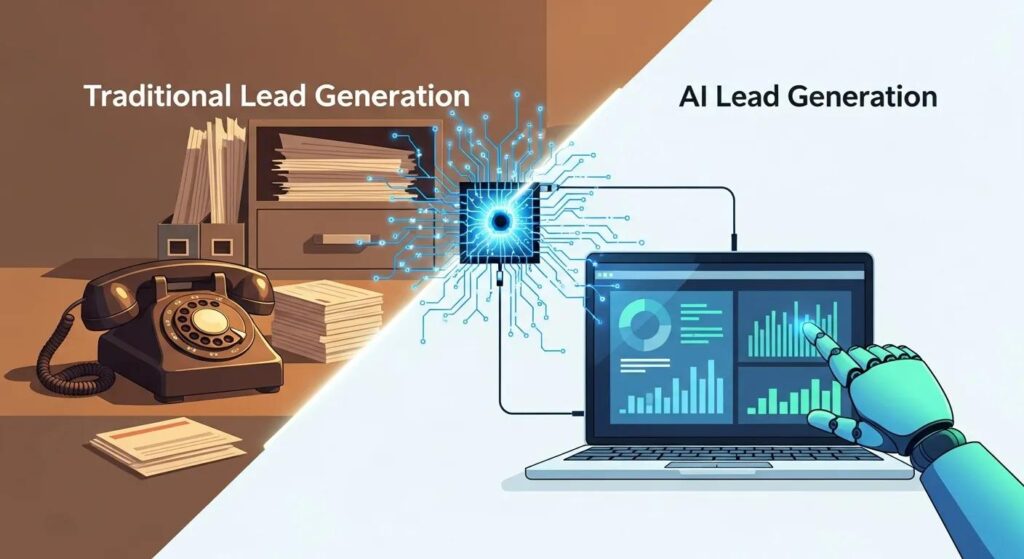
Traditional lead generation comprises manual techniques used over decades. Common examples include static forms, cold calling, and manual follow-up workflows. These approaches are labour-intensive and frequently underperform in engagement and conversion, creating operational inefficiencies and missed opportunities.
Typical manual techniques include cold calling, networking events, and direct mail campaigns. Each can produce leads but demands significant time and resources. Cold calling often yields low conversion rates, and networking can be inconsistent in generating qualified prospects.
Organisations relying on manual lead methods encounter several challenges. These include high time requirements for follow-up, lead leakage from slow responses, and limited personalisation at scale. Such inefficiencies underscore the need for more effective lead generation strategies .
AI enhances sales and marketing efficiency by automating repetitive tasks and delivering real-time insights. Data-driven algorithms help identify higher-quality prospects and enable more targeted engagement. Automation reduces manual workload and ensures continuous lead nurturing.
AI techniques such as predictive lead scoring and automated acquisition improve lead quality. Predictive analytics estimate conversion likelihood from historical data, allowing sales teams to prioritise effectively. Conversational AI provides real-time personalised interactions that improve the customer experience.
AI shortens qualification cycles by automating data analysis and lead nurturing. Advanced algorithms quickly surface high-potential leads so sales resources target the most promising opportunities. This focus increases return on investment and, according to recent studies, improves conversion rates and overall sales performance for companies adopting AI .
The principal differences are engagement method and operational efficiency. Traditional approaches depend on human intervention; AI replaces repetitive tasks with automation and analytics. The result is improved responsiveness and real-time evaluation of lead quality.
Automation combined with predictive analytics provides continuous, real-time insight into lead behaviour. Systems assess interactions and conversion probability, enabling immediate routing of high-quality leads to sales. This capability reduces latency and increases conversion potential.
Recent research further demonstrates AI’s substantial impact on lead scoring and opportunity management within CRM platforms.
AI vs. Traditional Lead Scoring: Enhancing Sales & Conversion
Lead scoring and opportunity management are critical functions in customer acquisition and revenue generation for modern enterprises. Traditional rule-based approaches often rely on static criteria, manual judgment, and historical heuristics, resulting in inaccurate prioritization, delayed conversions, and suboptimal sales outcomes. The emergence of Artificial Intelligence (AI) within Customer Relationship Management (CRM) platforms has fundamentally transformed how organizations identify, prioritize, and convert potential customers.
AI-Powered Lead Scoring and Opportunity Management in Salesforce CRM, GK Sangam, 2026
AI integration with CRM systems automates data entry and surfaces actionable insights for sales teams. This improves data consistency and provides real-time lead status, enabling more efficient handoffs and better conversion outcomes.
Maximising AI benefits requires targeted implementation strategies. Focus on attracting high-intent prospects and deploying automated follow-up mechanisms to ensure timely nurturing and higher conversion potential.
Effective AI adoption follows clear stages. Begin with discovery and needs analysis to define objectives. Prioritise tool implementation and integration, train teams to use the technology, and maintain continuous monitoring and optimisation to sustain performance gains.
Transition challenges are manageable with a structured approach. Align content strategies to AI capabilities and invest in technical improvements that support AI integration . Addressing these areas enables companies to migrate processes and realise the benefits of AI-driven lead generation.
Case studies and industry statistics consistently show efficiency gains and higher conversion rates for organisations that adopt AI in lead generation. These findings reinforce AI’s role in optimising marketing performance.
AI adoption has expanded across sectors, and many organisations report measurable improvements in lead conversion. The observed growth in AI use highlights its strategic importance for maintaining competitive marketing operations.
Reports from 2024–2026 document notable ROI improvements and time savings for businesses using AI in lead generation. Companies cite increased efficiency through automation alongside documented improvements in return on investment.
Evaluating cost-effectiveness requires a comparative analysis of conversion rates, operational efficiency, and total return on investment. Businesses should model both approaches against these metrics to identify the optimal allocation of resources.
AI lead generation is frequently more cost-effective than manual methods due to automation and lower ongoing labour requirements. Streamlined processes allow organisations to reallocate resources and pursue higher conversion outcomes with fewer personnel hours.
Measure AI success with key performance indicators such as lead-to-opportunity conversion rate, average response time, and engagement levels. Tracking these metrics lets you evaluate the effectiveness of your AI strategies and make informed, data-driven adjustments.
Relying exclusively on AI can risk over-automation and a reduced personal touch in customer interactions. AI may misinterpret signals, producing suboptimal targeting. Maintain human oversight to preserve relationship quality and interpret behavioural nuance.
Data privacy requires compliance with regulations such as GDPR and CCPA. Implement strong encryption, anonymisation where appropriate, and obtain explicit consent. Regular audits and compliance checks are essential to maintain trust and transparency.
AI lead generation delivers pronounced benefits in sectors that handle large datasets and require precise targeting, including technology, finance, real estate, and e‑commerce. In these industries, AI enhances lead quality and conversion effectiveness.
AI improves segmentation by analysing large datasets to reveal distinct behavioural patterns. Machine learning enables creation of refined segments by demographics, interests, and purchase behaviour, supporting personalised campaigns that increase engagement and conversion.
Machine learning enables systems to learn from historical lead data, detect trends, and predict future behaviour. This capability refines lead scoring, prioritisation, and targeting so sales teams concentrate on the most promising prospects. As models evolve, accuracy and decision quality improve.
Small businesses can implement AI lead generation using affordable, scalable platforms with user-friendly interfaces. By defining clear goals and applying data-driven insights, small firms can enhance lead generation without large upfront investments.
Adopting AI-driven lead generation transforms efficiency and conversion performance. Automating workflows and leveraging data insights enables more effective engagement with high-quality leads than traditional methods. The transition streamlines operations and increases return on investment, making AI essential for competitive marketing. Discover how our tailored AI solutions can elevate your lead generation strategy today.
For most modern businesses, AI-powered lead generation delivers 3x higher conversion rates than manual outreach.